

Cuban Crocodile
crocodylus rhombifer
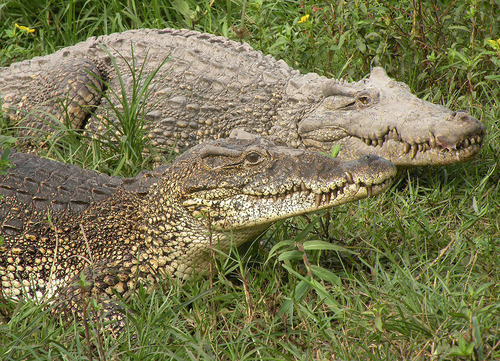
The Cuban crocodile (Crocodylus rhombifer) is a small to medium-sized crocodilian endemic only to Cuba's Zapata Swamp and the Lanier Swamp on the Isle of Youth. Renowned for its remarkable intelligence, curious nature, and highly aggressive temperament, this reptile is one of the most terrestrial of all crocodilians. Historically, it roamed across the Caribbean, but today it clings to the smallest geographic range of any living crocodile species, making it a critical focus for conservation efforts. What sets the Cuban crocodile apart is its agility. Unlike its larger relatives, it possesses strong, long legs that allow it to lift its body high off the ground, executing a high walk or even a bounding gallop. This physical prowess makes it a formidable predator both in shallow waters and on land, capturing the fascination of biologists and wildlife enthusiasts worldwide.
Hábitat: Found primarily in freshwater swamps, marshes, and damp cienegas of Cuba, preferring shallow waters with abundant vegetation.
Characterized by its striking, bright coloration, the Cuban crocodile features a highly contrasted pattern of yellow and black speckles, often referred to as a 'pebble' or 'mosaic' pattern. It has a relatively short, broad snout with a distinct bony ridge behind its eyes. Its eyes are set high on the head, and its heavily armored scales are adorned with raised, prominent ridges. Unlike many other crocodilians, its hind legs are notably longer and stronger than its front legs, and it lacks extensive webbing on its feet, which aids in its terrestrial mobility.
Categoría
ReptilesRareza
Common
Peligro
1/5 · Muy bajo
Snaps
¡Sé la primera persona en hacer un snap!
Fossil records suggest that Cuban crocodiles historically preyed on giant ground sloths before the sloths went extinct.
It is considered the most terrestrial of all living crocodiles, showcasing an ability to gallop on land at surprising speeds.
They are known to be highly curious and are considered by researchers to be the most intelligent and quick-learning of all crocodilians.
Possesses longer legs than other crocodilians, enabling it to perform a high-walk and even a bounding gallop to chase prey on land.
Capable of launching its entire body vertically out of the water to capture low-hanging birds or mammals from overhanging branches.
Exhibits highly coordinated group hunting behavior, a rarity among reptiles, to corner and take down larger prey items.
An opportunistic apex predator that feeds on a wide variety of fish, turtles, small mammals, and birds, utilizing both aquatic and land-based hunting strategies.
Diferencias por edad: Juveniles feed mostly on insects, small fish, and aquatic invertebrates, while adults transition to larger vertebrates like turtles and mammals.
Capromys pilorides
Preys heavily on this endemic rodent, often leaping out of the water to snatch them from low branches.
Trachemys decussata
Regularly preys on this freshwater turtle, crushing its hard shell with powerful jaws.
Crocodylus acutus
Competes for habitat and resources; hybridization between the two species poses a major genetic threat to the Cuban crocodile.
Aún no hay insignias de rasgos asignadas a este objeto.
Todavía no hay alias listados.
Las colecciones para este objeto aparecerán aquí a medida que se añadan más temas.
Peligro
1/5 · Muy bajo
Todavía no hay notas especiales de seguridad.
La forma más fácil de identificar a Cuban Crocodile es usar la aplicación de identificación de naturaleza Snappit.
200350+ cm
70.024+ kg
5075+ años
17 km/h
An opportunistic apex predator that feeds on a wide variety of fish, turtles, small mammals, and birds, utilizing both aquatic and land-based hunting strategies.
Found primarily in freshwater swamps, marshes, and damp cienegas of Cuba, preferring shallow waters with abundant vegetation.
Ambush
Acércate para separar los grupos y explorar dónde se ha fotografiado este objeto.
Los snaps recientes aparecerán aquí a medida que se añadan nuevas observaciones.

New York, US
Puedes ver León Africano, Tigre y Leopardo De Las Nieves.
Ver guía →

Texas, US
Puedes ver Dragón De Komodo y Camello Bactriano Doméstico.
Ver guía →

District of Columbia, US
Puedes ver Grevy's Zebra, Tortuga De Cuello Largo Oriental y Sitatunga.
Ver guía →