

Cushion Buckwheat
eriogonum ovalifolium
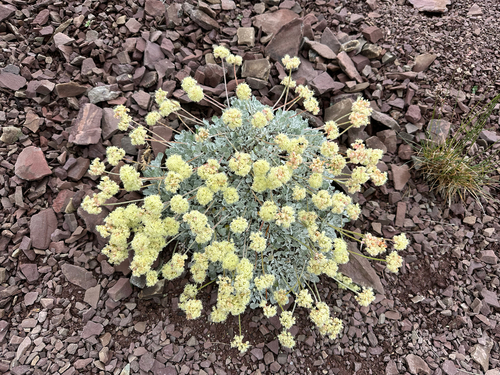
Cushion Buckwheat (Eriogonum ovalifolium) is an incredibly resilient, low-growing perennial herb native to the dry, mountainous regions of western North America. Forming dense, velvet-textured cushions or mats close to the stony ground, this plant is a marvel of adaptation to harsh, windswept environments. In late spring and summer, these compact, silvery-green mounds burst into a spectacular display of globe-like flower clusters, which transition beautifully from creamy white or yellow to deep shades of pink and rust. It plays a vital role in its native desert and alpine ecosystems, stabilizing loose gravelly soils and providing essential nourishment for diverse pollinators.
Hábitat: Found in dry, open sandy or gravelly slopes, sagebrush scrublands, and alpine ridges throughout western North America.
This plant is easily identified by its distinctive compact, cushion-like growth habit, typically rising only 5 to 20 cm off the ground. Its small, oval-shaped leaves are covered in dense, woolly white hairs that give the entire plant a silvery-sage or dusty-gray appearance. From these dense mats rise leafless, upright stems topped with spherical flower heads (1 to 3 cm in diameter). The tiny, bell-shaped flowers range in color from white and yellow to cream, turning pinkish, reddish, or papery brown as they age and dry out on the stem.
Categoría
PlantasRareza
Common
Peligro
1/5 · Muy bajo
Snaps
¡Sé la primera persona en hacer un snap!
Native American tribes, such as the Paiute and Shoshone, historically used various parts of this plant to make medicinal teas for colds.
The flower heads dry out beautifully on the living plant, changing from vibrant whites and yellows to papery rust-reds that can persist through winter.
The woolly hairs on the leaves of Cushion Buckwheat act like tiny sweaters, trapping a boundary layer of air to prevent water loss.
The dense covering of fine, white hairs on its leaves reflects intense solar radiation and significantly reduces moisture loss from drying wind.
Growing in a low, dense cushion minimizes exposure to harsh winds and helps trap heat near the ground in cold alpine environments.
It develops a robust, woody taproot that penetrates deep into rocky soils to access scarce water reserves and secure the plant.
As a photoautotroph, this plant produces its own energy through photosynthesis, utilizing sunlight, carbon dioxide, water, and minerals from the soil.
Apodemia mormo
Serves as an essential larval host plant and nectar source for the caterpillars and adult butterflies.
Andrena spp.
Pollinated by various native bees, which gather pollen and nectar from its abundant flowers.
Ovis canadensis
Sometimes grazed upon by big game animals when other food sources are scarce in rocky alpine terrains.
Aún no hay insignias de rasgos asignadas a este objeto.
Todavía no hay alias listados.
Las colecciones para este objeto aparecerán aquí a medida que se añadan más temas.
Peligro
1/5 · Muy bajo
Todavía no hay notas especiales de seguridad.
La forma más fácil de identificar a Cushion Buckwheat es usar la aplicación de identificación de naturaleza Snappit.
5-20 cm
5-20 años
As a photoautotroph, this plant produces its own energy through photosynthesis, utilizing sunlight, carbon dioxide, water, and minerals from the soil.
Found in dry, open sandy or gravelly slopes, sagebrush scrublands, and alpine ridges throughout western North America.
Acércate para separar los grupos y explorar dónde se ha fotografiado este objeto.
Los snaps recientes aparecerán aquí a medida que se añadan nuevas observaciones.













_Anacamptis_pyramidalis_-_Inflorescence.jpg&width=800)