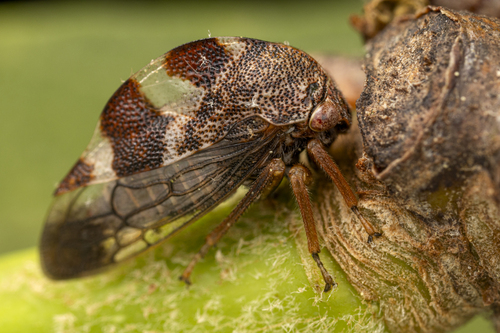


Cyrtolobus Tuberosus
cyrtolobus tuberosus
Cyrtolobus tuberosus, commonly known as a treehopper, is a fascinating member of the Membracidae family, renowned for its distinctive and often bizarre pronotal extensions. These small insects spend their lives primarily on the woody stems and branches of deciduous trees, where they feed on sap. They are masters of camouflage, their body shapes and colors allowing them to blend seamlessly with bark, thorns, or buds, making them incredibly difficult to spot. Their presence often goes unnoticed due to their cryptic nature and small size, yet they play a subtle role in forest ecosystems, serving as a food source for various predators and forming intriguing mutualistic relationships with ants.
Hábitat: Found in deciduous forests, woodlands, and areas with abundant oak trees, where they feed on plant sap.
Cyrtolobus tuberosus is a small insect, typically measuring between 5 to 8 millimeters in length. Its most striking feature is its helmet-like pronotum, which extends backward over its body, often exhibiting a 'tubercular' or humped appearance that aids in its camouflage. The coloration usually ranges from mottled browns and grays to greenish hues, perfectly mimicking bark, twigs, or lichen. They possess translucent wings, often veined, which are typically held tent-like over their bodies at rest, and small, dark eyes.
Categoría
InsectosRareza
Common
Peligro
1/5 · Muy bajo
Snaps
¡Sé la primera persona en hacer un snap!
Cyrtolobus tuberosus belongs to the Membracidae family, infamous for some of the most bizarre and elaborate pronotal (first segment of the thorax) modifications in the insect world.
Despite their small size, treehoppers are capable of powerful jumps and short flights, aiding in escape from predators and movement between feeding sites.
Like many other sap-feeding insects, C. tuberosus excretes a sugary waste product called honeydew, which is a valuable food source for ants, leading to mutualistic relationships where ants protect them.
Nymphs (immature treehoppers) often live in aggregations on the host plant, and they can sometimes be seen moving in sync, a behavior thought to confuse predators.
The unique, often humped or knobby shape of its pronotum allows it to perfectly mimic parts of its host plant, such as thorns, bark irregularities, or buds, making it nearly invisible to predators.
Equipped with a specialized piercing-sucking mouthpart (proboscis), Cyrtolobus tuberosus efficiently extracts nutrient-rich phloem sap from the stems and branches of host trees, primarily oaks.
Treehoppers communicate with each other through substrate-borne vibrations transmitted through their host plants, allowing them to find mates and warn of predators without attracting unwanted attention.
Cyrtolobus tuberosus is a herbivorous insect that feeds exclusively on the phloem sap of various woody plants, extracting nutrients with its specialized mouthparts.
Diferencias por edad: Nymphs and adults share the same diet, both feeding on plant sap.
Quercus spp.
Primary host plant and food source
Formica spp.
Ants often tend treehoppers to collect the sugary honeydew they excrete, in return providing protection from predators.
Sphecidae spp.
Common predator of small insects, including treehoppers.
Parulidae spp.
Various small insectivorous birds will forage on treehoppers if they are spotted.
Aún no hay insignias de rasgos asignadas a este objeto.
Todavía no hay alias listados.
Las colecciones para este objeto aparecerán aquí a medida que se añadan más temas.
Peligro
1/5 · Muy bajo
Todavía no hay notas especiales de seguridad.
La forma más fácil de identificar a Cyrtolobus Tuberosus es usar la aplicación de identificación de naturaleza Snappit.
0 cm
1-2 cm
0 kg
0 años
Cyrtolobus tuberosus is a herbivorous insect that feeds exclusively on the phloem sap of various woody plants, extracting nutrients with its specialized mouthparts.
Found in deciduous forests, woodlands, and areas with abundant oak trees, where they feed on plant sap.
Grazing
Acércate para separar los grupos y explorar dónde se ha fotografiado este objeto.
Los snaps recientes aparecerán aquí a medida que se añadan nuevas observaciones.












