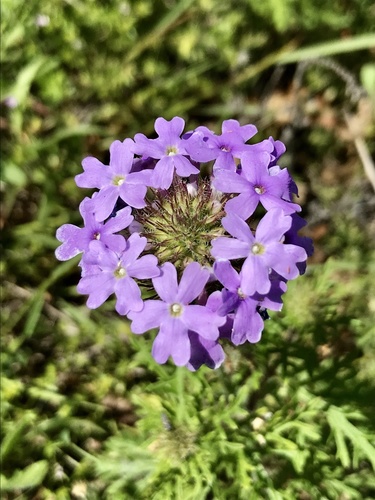


Dakota Mock Vervain
glandularia bipinnatifida
Dakota Mock Vervain (Glandularia bipinnatifida) is a hardy, low-growing perennial wildflower native to the prairies and open woodlands of North America. Renowned for its extreme resilience, this plant blankets dry fields, plains, and roadsides with dense clusters of lavender to purple blossoms from early spring until the first winter frost. Its ability to thrive in poor, rocky soils makes it an essential pioneer species in disturbed habitats, helping to stabilize soil and prevent erosion in arid environments. Beyond its tough nature, the Dakota Mock Vervain plays a vital role in supporting local ecosystems. It acts as a critical nectar source for a vast array of native bees, butterflies, and other beneficial pollinators. Gardeners and native plant enthusiasts highly value this species for xeriscaping and rock gardens due to its prolonged blooming period, drought tolerance, and low maintenance requirements.
Hábitat: Found in dry prairies, plains, open meadows, rocky limestone hillsides, and disturbed areas like roadsides.
This species is a decumbent to erect herbaceous plant, typically reaching heights of 15 to 45 centimeters, with sprawling stems that can root where they touch the ground. It features highly textured, hairy leaves that are deeply twice-pinnately lobed (bipinnatifid), giving the foliage a feathery appearance. The flowers are small, trumpet-shaped, and five-lobed, tightly gathered into rounded, flat-topped spikes that elongate as they mature. Bloom colors vary from pale lavender and pink to deep violet-purple, often displaying a lighter center within each flower.
Categoría
PlantasRareza
Common
Peligro
1/5 · Muy bajo
Snaps
¡Sé la primera persona en hacer un snap!
Despite its delicate, lace-like appearance, it is incredibly tough and is often one of the few plants still blooming vibrantly during intense summer heatwaves.
The flowers often change hue slightly from pink to deep purple as they are pollinated and age, signaling to visiting insects which blooms are freshest.
The species name 'bipinnatifida' directly translates to 'twice pinnately cut', describing the intricate, feathery appearance of its deeply divided leaves.
Possesses deep taproots and a dense covering of fine, protective hairs on its stems and leaves to reduce transpiration and conserve moisture in arid climates.
Capable of producing new flower clusters continuously from spring to fall, ensuring a persistent reproductive effort and food supply for pollinators.
Decumbent stems can form adventitious roots when they come into contact with moist soil, allowing the plant to spread vegetatively and stabilize loose terrain.
As a photoautotrophic plant, it manufactures its own organic compounds through photosynthesis using sunlight, water, and carbon dioxide, aided by essential mineral nutrients absorbed by its root system.
Danaus plexippus
Provides a crucial source of nectar for adult butterflies during their long migration.
Junonia coenia
Serves as an important larval host plant for the caterpillars of this butterfly species.
Halictus ligatus
Frequently visited by native sweat bees seeking both nectar and pollen, aiding in the plant's pollination.
Aún no hay insignias de rasgos asignadas a este objeto.
Todavía no hay alias listados.
Las colecciones para este objeto aparecerán aquí a medida que se añadan más temas.
Peligro
1/5 · Muy bajo
Todavía no hay notas especiales de seguridad.
La forma más fácil de identificar a Dakota Mock Vervain es usar la aplicación de identificación de naturaleza Snappit.
15-45 cm
2-5 años
As a photoautotrophic plant, it manufactures its own organic compounds through photosynthesis using sunlight, water, and carbon dioxide, aided by essential mineral nutrients absorbed by its root system.
Found in dry prairies, plains, open meadows, rocky limestone hillsides, and disturbed areas like roadsides.
Photosynthesis
Acércate para separar los grupos y explorar dónde se ha fotografiado este objeto.
Los snaps recientes aparecerán aquí a medida que se añadan nuevas observaciones.

















