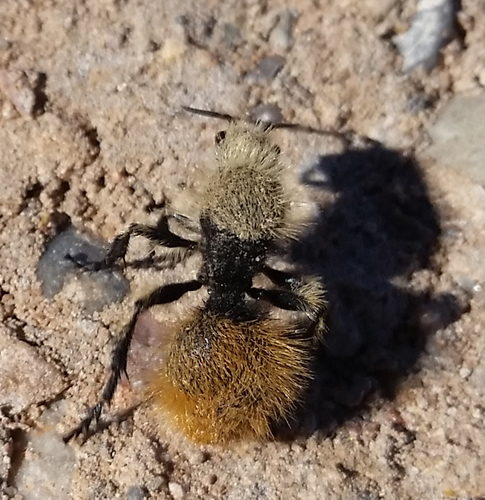


Dasymutilla Magna
dasymutilla magna
Dasymutilla magna, comúnmente conocida como hormiga de terciopelo, es un insecto llamativo y fascinante perteneciente a la familia Mutillidae. A pesar de su nombre común y apariencia de hormiga, estas criaturas son en realidad avispas solitarias. Las hembras son completamente ápteras y corren rápidamente por suelos arenosos, mientras que los machos poseen alas transparentes y pasan gran parte de su tiempo volando bajo en busca de pareja. Sus vibrantes y densas capas de pelo afelpado actúan como coloración de advertencia aposemática, señalizando a los posibles depredadores que son peligrosas. Lo que hace que Dasymutilla magna sea verdaderamente notable es su formidable conjunto de defensas. Las hembras poseen un aguijón excepcionalmente largo en relación con el tamaño de su cuerpo, que proporciona una picadura notoriamente dolorosa que ha valido a sus parientes el apodo de 'asesinas de vacas'. Además, lucen un exoesqueleto increíblemente grueso, similar a una armadura, que las protege de las mordeduras y picaduras defensivas de las abejas y avispas que anidan en el suelo, cuyos nidos invaden para depositar sus huevos.
Hábitat: Se encuentra predominantemente en ambientes áridos y semiáridos, incluyendo matorrales desérticos, dunas de arena y pastizales secos con vegetación escasa.
Esta especie se caracteriza por un cuerpo robusto y algo alargado que mide aproximadamente de 1 a 3 centímetros de longitud. Las hembras son ápteras y están densamente cubiertas de setas (pelos) ásperas y aterciopeladas que suelen ser de un vibrante color naranja amarillento a rojo óxido en el tórax y el abdomen, contrastando fuertemente con sus patas, antenas y parte inferior de color negro brillante. Los machos comparten una coloración similar, aunque a veces más apagada, pero se distinguen fácilmente por la presencia de alas grandes, translúcidas y de tono oscuro. Ambos sexos poseen exoesqueletos pesados y blindados que les confieren una apariencia distintivamente rígida y robusta al moverse.
Categoría
InsectosRareza
Common
Peligro
1/5 · Muy bajo
Snaps
2
A pesar de ser llamadas 'hormigas de terciopelo', en realidad son una familia de avispas solitarias donde las hembras han perdido completamente sus alas a través de la evolución.
Los colores brillantes naranja y rojo de este insecto son un ejemplo clásico de aposematismo, una estrategia biológica utilizada para anunciar peligro a posibles depredadores.
El exoesqueleto de una hormiga de terciopelo es tan excepcionalmente duro que los entomólogos a veces doblan sus alfileres de montaje de acero al intentar añadirlas a una colección de museo.
Su picadura es increíblemente dolorosa, famosa por ocupar un lugar destacado en el índice de dolor de picaduras de Schmidt, aunque su veneno es relativamente no tóxico para los humanos.
Los adultos se alimentan principalmente de néctar y agua, mientras que su etapa larval es estrictamente carnívora, desarrollándose como ectoparasitoides en las etapas inmaduras de otros insectos.
Diferencias por edad: Las larvas son ectoparasitoides completamente carnívoras que se alimentan de un solo insecto hospedador, mientras que los adultos cambian completamente a una dieta líquida de néctar de plantas y agua.
Aún no hay insignias de rasgos asignadas a este objeto.
Todavía no hay alias listados.
Las colecciones para este objeto aparecerán aquí a medida que se añadan más temas.
Peligro
1/5 · Muy bajo
Todavía no hay notas especiales de seguridad.
La forma más fácil de identificar a Dasymutilla Magna es usar la aplicación de identificación de naturaleza Snappit.
1-3 cm
1-3 cm
0.0001-0.0005 kg
0-1 años
Los adultos se alimentan principalmente de néctar y agua, mientras que su etapa larval es estrictamente carnívora, desarrollándose como ectoparasitoides en las etapas inmaduras de otros insectos.
Se encuentra predominantemente en ambientes áridos y semiáridos, incluyendo matorrales desérticos, dunas de arena y pastizales secos con vegetación escasa.
Búsqueda De Alimento
Acércate para separar los grupos y explorar dónde se ha fotografiado este objeto.
Llévate el descubrimiento
Haz una foto con Snappit, identifica la especie y guarda el hallazgo en tu colección.














.jpg&width=800)




