

Delonix
delonix
El género Delonix consiste en magníficos árboles caducifolios en flor, nativos de Madagascar y partes de África Oriental, mundialmente reconocidos por sus espectaculares exhibiciones florales. Comúnmente conocidos como flamboyanes o poincianas, estos árboles son celebrados por sus copas extensas en forma de paraguas que se cubren completamente de brillantes flores escarlata, naranjas o amarillas durante la estación cálida. Más allá de su atractivo estético, las especies de Delonix desempeñan un importante papel ecológico, proporcionando sombra, estabilizando los suelos y albergando una diversa variedad de polinizadores. Se han adaptado notablemente bien a climas tropicales y subtropicales, lo que los convierte en uno de los árboles ornamentales más apreciados cultivados en todo el mundo.
Hábitat: Se encuentra típicamente en bosques tropicales secos, laderas rocosas y matorrales costeros de Madagascar, aunque ampliamente cultivado en jardines urbanos y parques a nivel global.
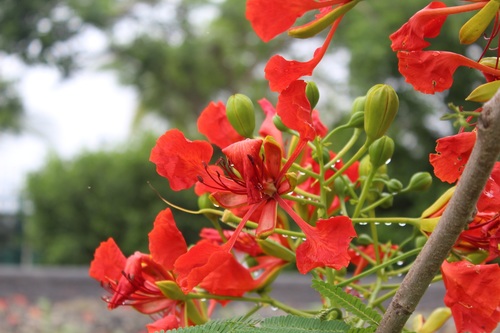
Estos árboles son fácilmente reconocibles por su enorme y extendida copa que forma una elegante silueta en forma de paraguas aplanado, alcanzando típicamente alturas de 5 a 15 metros. El tronco es de color marrón grisáceo y liso, a menudo con raíces tabulares en la base. Las hojas son de color verde brillante, bipinnadas compuestas, y tienen una apariencia suave, similar a la de un helecho. Cuando está en flor, el árbol es una explosión de color, caracterizado por grandes flores con cuatro pétalos extendidos de color escarlata o rojo anaranjado y un quinto pétalo erguido, llamado estandarte, que es ligeramente más grande y salpicado de manchas amarillas y blancas.
Categoría
PlantasRareza
Común
Peligro
1/5 · Muy bajo
Snaps
¡Sé la primera persona en hacer un snap!
En Vietnam, donde el árbol florece alrededor del final del año escolar, se le apoda la 'flor del estudiante' y ocupa un lugar nostálgico en la cultura estudiantil.
En muchas naciones caribeñas, las vainas de semillas secas y leñosas de Delonix se utilizan como instrumento de percusión conocido como shak-shaks o maracas.
El nombre común 'Poinciana' honra a Phillippe de Longvilliers de Poincy, un gobernador de Saint Kitts del siglo XVII que fue un ávido promotor del árbol.
El árbol es excepcionalmente resistente al viento debido a su madera flexible y su copa baja y extendida, lo que lo convierte en un valioso cortavientos en áreas costeras tropicales propensas a tormentas.
Forma asociaciones beneficiosas con bacterias del suelo para convertir el nitrógeno atmosférico en nutrientes, mejorando la calidad del suelo circundante.
Pierde completamente sus hojas durante períodos secos prolongados para conservar agua y sobrevivir a condiciones de sequía extrema.
Presenta una copa excepcionalmente ancha y plana que maximiza la captura de luz mientras sombrea su propio sistema de raíces para reducir la evaporación.
Como planta fotoautótrofa, Delonix genera sus propios compuestos orgánicos y energía a través de la fotosíntesis, utilizando la luz solar, el agua, el dióxido de carbono y los minerales del suelo.
Diferencias por edad: Las plántulas dependen de las reservas de nutrientes almacenadas dentro de los cotiledones de la semilla antes de desarrollar hojas funcionales para la fotosíntesis.
Apis mellifera
Las abejas visitan las vibrantes flores para recolectar néctar y polen, actuando como polinizadores primarios del árbol.
Achatina fulica
Esta especie de caracol invasora a menudo se alimenta de las plántulas jóvenes tiernas y las hojas caídas de los árboles de Delonix.
Phoebis sennae
Las mariposas se alimentan del abundante néctar que ofrecen las flores y contribuyen a la polinización cruzada.
Aún no hay insignias de rasgos asignadas a este objeto.
Las colecciones para este objeto aparecerán aquí a medida que se añadan más temas.
Peligro
1/5 · Muy bajo
Todavía no hay notas especiales de seguridad.
Empieza por la planta entera y luego compara la disposición de las hojas, sus bordes, los tallos y las flores o frutos, si los hay. Las hojas opuestas crecen en parejas; las alternas salen de una en una a lo largo del tallo. Juntos, estos detalles dicen mucho más que una sola hoja verde. Identificador de plantas: sube una foto y compara los detalles visibles.
500-1500 cm
2000-15000 kg
30-80 años
Como planta fotoautótrofa, Delonix genera sus propios compuestos orgánicos y energía a través de la fotosíntesis, utilizando la luz solar, el agua, el dióxido de carbono y los minerales del suelo.
Se encuentra típicamente en bosques tropicales secos, laderas rocosas y matorrales costeros de Madagascar, aunque ampliamente cultivado en jardines urbanos y parques a nivel global.
12-30 días
Acércate para separar los grupos y explorar dónde se ha fotografiado este objeto.
Los snaps recientes aparecerán aquí a medida que se añadan nuevas observaciones.

Texas, US
Puedes ver Jirafas, León Africano y Rinoceronte Negro Oriental.
Ver guía →

Nouvelle-Aquitaine, FR
Puedes ver Flamenco Común, Jirafas y Panda Rojo.
Ver guía →

Kansas, US
Puedes ver Tití León De Cabeza Blanca, Bisonte Americano y Puma.
Ver guía →

Nevada, US
Puedes ver León Africano, Tigre y Cebra.
Ver guía →

Andalusia, ES
Puedes ver Tigre, León Africano y Delonix.
Ver guía →

Indiana, US
Puedes ver Jirafas, León Africano y Tigre.
Ver guía →
Llévate el descubrimiento
Haz una foto con Snappit, identifica la especie y guarda el hallazgo en tu colección.