

Dense-Flowered Orchid
neotinea maculata
The Dense-Flowered Orchid is a small, terrestrial orchid native to the Mediterranean region, Western Europe, and Macaronesia. Despite its humble size, this species is highly adapted to surviving in dry, nutrient-poor soils, relying heavily on symbiotic relationships with underground fungi to germinate and thrive. It adds a delicate beauty to calcareous grasslands and open woodlands, though it is often easily overlooked due to its pale coloring. Unlike many of its flashier relatives, it has evolved a highly efficient strategy of self-pollination, ensuring its reproduction even in areas with sparse insect activity. This resilient orchid remains a fascinating subject for botanists studying plant-fungal relationships and evolutionary biology.
Hábitat: Found in open pine forests, scrublands, pastures, and rocky limestone slopes across the Mediterranean and Western Europe.
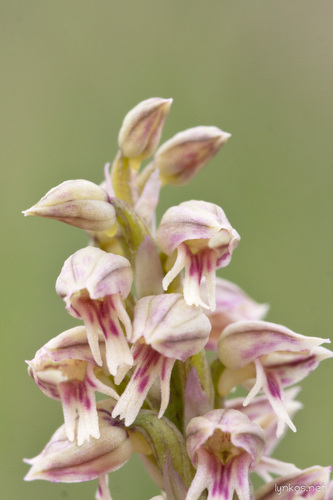
Typically standing between 10 and 30 centimeters tall, this orchid is easily identified by its dense, cylindrical flower spike tightly packed with tiny, tubular blossoms. The flowers range in color from pale pink and yellowish-white to light greenish-straw, with a three-lobed lip that is often decorated with minute purple dots. Its leaves are lance-shaped, grey-green, and frequently covered in dark purple spots, although unspotted varieties do occur in some populations.
Categoría
PlantasRareza
Common
Peligro
1/5 · Muy bajo
Snaps
¡Sé la primera persona en hacer un snap!
Its scientific species name 'maculata' translates to 'spotted' in Latin, referring to the dark spots on its leaves.
The seeds of this orchid are as tiny as dust particles and lack any internal food reserves, meaning they cannot sprout without finding a fungal partner.
While most orchids rely on elaborate mimics or sweet nectars to lure insects, the Dense-Flowered Orchid can fertilize itself without any pollinators.
Relies closely on subterranean fungi to provide nutrients and water essential for seed germination and early development.
Capable of self-pollination within its tightly packed flowers, allowing successful seed production without insect pollinators.
Survives hot, arid summer months completely underground as a dormant tuber, re-emerging with the autumn rains.
As a photoautotrophic plant, it produces its own energy via photosynthesis, but depends on mycorrhizal fungi for minerals and water.
Diferencias por edad: Seedlings rely entirely on symbiotic fungi for carbon until developing green leaves to photosynthesize.
Tulasnella calospora
Forms a vital symbiotic relationship where the fungus provides minerals and water to the orchid's root system.
Oryctolagus cuniculus
Occasionally grazes on the leaves and flower spikes of this orchid in open meadows.
Aún no hay insignias de rasgos asignadas a este objeto.
Todavía no hay alias listados.
Las colecciones para este objeto aparecerán aquí a medida que se añadan más temas.
Peligro
1/5 · Muy bajo
Todavía no hay notas especiales de seguridad.
La forma más fácil de identificar a Dense-Flowered Orchid es usar la aplicación de identificación de naturaleza Snappit.
10-30 cm
3-10 años
As a photoautotrophic plant, it produces its own energy via photosynthesis, but depends on mycorrhizal fungi for minerals and water.
Found in open pine forests, scrublands, pastures, and rocky limestone slopes across the Mediterranean and Western Europe.
Acércate para separar los grupos y explorar dónde se ha fotografiado este objeto.
Los snaps recientes aparecerán aquí a medida que se añadan nuevas observaciones.