

Desert Bluebells
phacelia campanularia
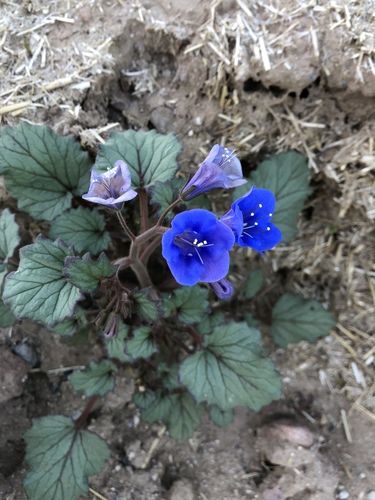
Desert Bluebells, known scientifically as Phacelia campanularia, are breathtaking spring ephemerals that transform the arid, sun-baked landscapes of the Mojave and Sonoran deserts into vivid carpets of cobalt blue. Surviving in some of the harshest environments in North America, these resilient annuals employ a highly specialized life cycle. They endure the blistering summer heat as dormant seeds hidden beneath the sandy soil, patiently awaiting heavy winter rains. Once the moisture arrives, they rapidly germinate, grow, and burst into brilliant bloom, rushing to complete their life cycle before the oppressive heat returns. Beyond their striking aesthetic appeal, Desert Bluebells are a vital component of the desert ecosystem. Their nectar-rich, bell-shaped flowers serve as a critical food source for native bees and butterflies emerging in the early spring. The intense blue of their petals acts as a beacon across the barren terrain, drawing in pollinators from afar. Whether encountered as an isolated splash of color against a rocky wash or as part of a rare, spectacular desert superbloom, these fascinating wildflowers are a true testament to the tenacity and unexpected beauty of desert flora.
Hábitat: Found predominantly in well-draining, sandy washes, gravelly slopes, and open desert scrub environments across the Mojave and Sonoran deserts.
Phacelia campanularia is a low-growing herbaceous plant that typically reaches 10 to 70 centimeters in height. Its most distinctive feature is its vibrant, deep cobalt-blue flowers, which are bell-shaped and measure about 2 to 4 centimeters across. Each blossom consists of five fused petals surrounding prominent, protruding stamens topped with bright yellow or white pollen. The leaves are broad, oval to heart-shaped with coarsely toothed or scalloped margins, and exhibit a slightly purplish tint along their edges. The plant's reddish-green stems and foliage are densely coated in short, stiff, glandular hairs, giving the plant a fuzzy texture and a sticky feel that can secrete a mildly irritating resin.
Categoría
PlantasRareza
Common
Peligro
1/5 · Muy bajo
Snaps
¡Sé la primera persona en hacer un snap!
Desert bluebell seeds can lie dormant in the scorching desert sand for years, waiting for the perfect combination of winter rain to trigger a massive spring bloom.
The plant is sometimes called desert scorpionweed due to its tightly coiled flower clusters that resemble a scorpion tail before they fully bloom.
The vibrant blue color of its petals comes from complex anthocyanin pigments, which rarely appear this vividly in hot, arid environments.
Touching the hairy stems and leaves can cause a mild skin rash in sensitive individuals, similar to poison oak, thanks to a defensive oil.
The stems and leaves secrete oils through tiny hairs that deter herbivores and reduce water loss, though they can cause contact dermatitis in humans.
It survives harsh desert summers as a dormant seed, quickly germinating and flowering only when sufficient winter rain provides a brief window of moisture.
The flowers feature ultraviolet patterns invisible to humans but highly visible to native bees, guiding them directly to the pollen and nectar.
As a photosynthetic plant, it produces its own energy using sunlight, water, and atmospheric carbon dioxide.
Bombus sonorus
Serves as a critical early-spring nectar source for native pollinators.
Eschscholzia californica
Competes for sunlight and water during the brief spring growing season.
Neotoma lepida
Occasionally consumes the foliage despite the irritating glandular hairs.
Aún no hay insignias de rasgos asignadas a este objeto.
Todavía no hay alias listados.
Las colecciones para este objeto aparecerán aquí a medida que se añadan más temas.
Peligro
1/5 · Muy bajo
Todavía no hay notas especiales de seguridad.
La forma más fácil de identificar a Desert Bluebells es usar la aplicación de identificación de naturaleza Snappit.
10-70 cm
0-1 años
As a photosynthetic plant, it produces its own energy using sunlight, water, and atmospheric carbon dioxide.
Found predominantly in well-draining, sandy washes, gravelly slopes, and open desert scrub environments across the Mojave and Sonoran deserts.
7-30 días
Acércate para separar los grupos y explorar dónde se ha fotografiado este objeto.
Los snaps recientes aparecerán aquí a medida que se añadan nuevas observaciones.










_(14586807078).jpg&width=800)






