

Desert Fivespot
eremalche rotundifolia
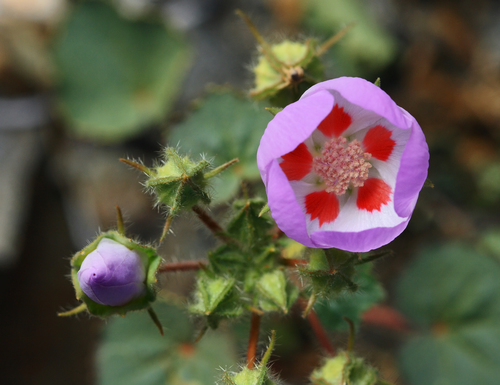
The Desert Fivespot (Eremalche rotundifolia) is one of the most enchanting sights of the American Southwest's desert ecosystems. Rising as a delicate annual wildflower amidst harsh, arid environments, this member of the mallow family brings a splash of vivid color to gravelly slopes and sandy washes. Its common name perfectly describes its most striking feature: five cup-shaped petals adorned with a distinct red or purple spot at the base of each. These flowers act as natural solar collectors, tracking the path of the sun to keep their reproductive organs warm and attractive to insect pollinators. For hikers and nature enthusiasts, catching a glimpse of a desert hillside covered in blooming Fivespots during a rare 'superbloom' is an unforgettable experience, symbolizing the surprising resilience and beauty of desert life.
Hábitat: Found in dry, open gravelly washes, desert flats, and creosote bush scrub below 1,200 meters elevation in the Mojave and Sonoran deserts.
This annual herb grows between 10 and 60 centimeters tall, featuring erect, reddish-purple stems covered in fine, bristly hairs. Its leaves are dark green, thick, nearly round to kidney-shaped, with scalloped or toothed margins, measuring about 2 to 5 centimeters wide. The most diagnostic feature is the bowl-shaped flower, which spans 2 to 5 centimeters across. The petals are a delicate shade of pale pink to rose-purple, each marked with a brilliant, dark magenta-to-crimson spot at its base, forming a perfect ring of five spots around the central cluster of yellow stamens.
Categoría
PlantasRareza
Common
Peligro
1/5 · Muy bajo
Snaps
¡Sé la primera persona en hacer un snap!
Its seeds possess thick protective coats and can remain dormant in dry desert soil for decades, germinating only when specific rainfall thresholds are reached.
The five crimson spots inside the cup function as 'nectar guides', directing pollinating insects straight to the flower's reproductive center.
When backlit by the low desert sun, the semi-translucent pink petals glow brightly, earning them the nickname of nature's paper lanterns.
Utilizes highly efficient heliotropism to track the sun's movement, heating the interior of the blossom to attract cold-blooded insect pollinators.
Completes its entire lifecycle from germination to seed production in a matter of weeks following winter rains, allowing it to bypass summer droughts.
The cup-like petals close tightly at night to trap daytime warmth, protecting sensitive pollen and reproductive organs from freezing desert temperatures.
As a photoautotrophic plant, the Desert Fivespot produces its own food through photosynthesis, utilizing chlorophyll to convert sunlight, carbon dioxide, and water into sugars.
Anthophora linsleyi
Pollinated by this specialized ground-nesting desert bee, which is drawn to the warm, wind-protected interior of the flower.
Gopherus agassizii
This herbivorous reptile consumes the nutritious foliage and flowers during spring foraging.
Larrea tridentata
Often grows in the shelter of this nurse plant, which provides partial shade and retains critical soil moisture.
Aún no hay insignias de rasgos asignadas a este objeto.
Todavía no hay alias listados.
Las colecciones para este objeto aparecerán aquí a medida que se añadan más temas.
Peligro
1/5 · Muy bajo
Todavía no hay notas especiales de seguridad.
La forma más fácil de identificar a Desert Fivespot es usar la aplicación de identificación de naturaleza Snappit.
10+ cm
0.01+ kg
0+ años
As a photoautotrophic plant, the Desert Fivespot produces its own food through photosynthesis, utilizing chlorophyll to convert sunlight, carbon dioxide, and water into sugars.
Found in dry, open gravelly washes, desert flats, and creosote bush scrub below 1,200 meters elevation in the Mojave and Sonoran deserts.
Acércate para separar los grupos y explorar dónde se ha fotografiado este objeto.
Los snaps recientes aparecerán aquí a medida que se añadan nuevas observaciones.

California, US
Puedes ver Arbusto De Creosota, Desert Holly y Cottontop Cactus.
Ver guía →

California, US
Puedes ver Iodinebush, Yerba Mansa y Golden Gilmania.
Ver guía →

California, US
Puedes ver Desert Holly, Desert Sunflower y Desert Fivespot.
Ver guía →













.jpg&width=800)

