

Desert Milkweed
asclepias erosa
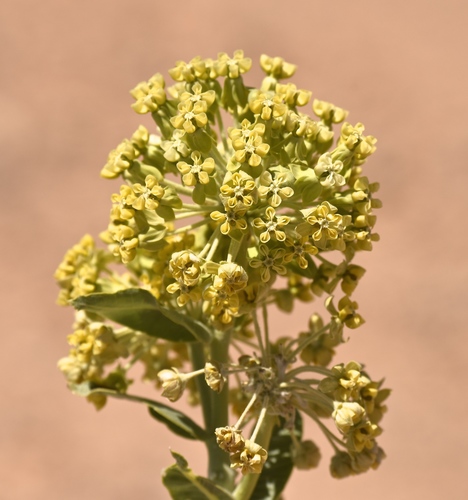
Desert Milkweed (Asclepias erosa) is a robust, erect perennial herb native to the arid desert regions of the southwestern United States and northwestern Mexico. It stands out in barren landscapes with its thick, fibrous stems and large, coarse, pale green leaves. During the intense heat of late spring and summer, it produces dense, globe-like clusters of pale yellow to greenish-white flowers that act as critical nectar oases for desert pollinators. Like other milkweeds, it produces a sticky, milky latex sap filled with toxic cardenolides, which serves as a powerful defense mechanism against generalist herbivores while hosting highly specialized insect species.
Hábitat: Found in sandy, gravelly washes, desert flats, disturbed roadsides, and dry slopes below 1,500 meters in arid desert regions.
This sturdy perennial grows up to 60 to 200 centimeters tall, featuring stout, erect stems typically covered in fine, velvety white hairs. Its large, opposite leaves are sessile, broadly oval-to-lanceolate, and have a distinctive pale grayish-green hue with prominent white veins. The plant is easily recognized by its spectacular spherical flower clusters (umbels) that measure 5 to 10 centimeters across, containing numerous small, 5-petaled flowers ranging in color from cream to pale yellow-green. Following pollination, it produces large, teardrop-shaped seed pods that split open to release flat, brown seeds attached to silky white tufts.
Categoría
PlantasRareza
Common
Peligro
1/5 · Muy bajo
Snaps
¡Sé la primera persona en hacer un snap!
Indigenous peoples of the Southwest historically harvested the fibers from the plant's tough, woody stems to spin extremely strong cordage for bowstrings and nets.
The toxic cardiac glycosides concentrated in this plant are sequestered by monarch caterpillars, making both the caterpillar and the adult butterfly poisonous to birds.
Unlike typical flowers that disperse loose pollen grains, Desert Milkweed packages its pollen in specialized, sticky structures called pollinia that clip onto the legs of visiting insects.
Produces a thick, sticky white latex sap rich in cardiac glycosides (cardenolides) that are highly toxic to most generalist herbivores.
Stems and leaves are covered in fine, velvety trichomes (hairs) that reflect intense desert sunlight and reduce moisture loss from wind.
Develops lightweight seeds equipped with silky, floss-like hairs that easily catch desert drafts to colonize distant areas.
As a photosynthetic plant, it generates its own energy from sunlight, water, and carbon dioxide, while drawing minerals from the desert soil.
Danaus plexippus
Acts as a primary larval host plant where caterpillars feed on leaves, absorbing cardenolides to become toxic to predators.
Danaus gilippus
Provides essential foliage for caterpillars and nectar for adult butterflies in extreme desert environments.
Pepsis grossa
Adult wasps feed heavily on the abundant, high-energy nectar produced by the flowers, aiding in pollination.
Aún no hay insignias de rasgos asignadas a este objeto.
Todavía no hay alias listados.
Las colecciones para este objeto aparecerán aquí a medida que se añadan más temas.
Peligro
1/5 · Muy bajo
Todavía no hay notas especiales de seguridad.
La forma más fácil de identificar a Desert Milkweed es usar la aplicación de identificación de naturaleza Snappit.
60-200 cm
3-15 años
As a photosynthetic plant, it generates its own energy from sunlight, water, and carbon dioxide, while drawing minerals from the desert soil.
Found in sandy, gravelly washes, desert flats, disturbed roadsides, and dry slopes below 1,500 meters in arid desert regions.
Photosynthesis
Acércate para separar los grupos y explorar dónde se ha fotografiado este objeto.
Los snaps recientes aparecerán aquí a medida que se añadan nuevas observaciones.











