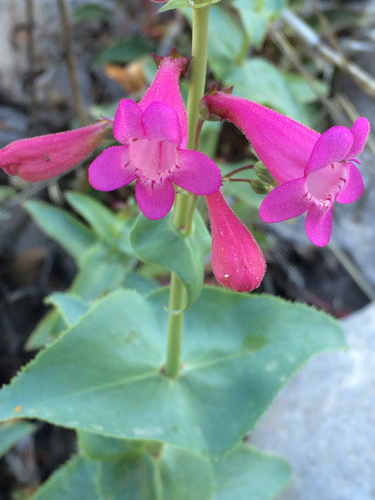


Desert Penstemon
penstemon pseudospectabilis
The Desert Penstemon (Penstemon pseudospectabilis), also known as desert beardtongue, is a striking perennial wildflower native to the southwestern United States. Thriving in the arid soils of deserts, canyons, and rocky slopes, this resilient plant stands out with its vibrant pink to magenta trumpet-shaped flowers. It plays a crucial ecological role, drawing in a variety of local pollinators, especially hummingbirds, with its nectar-rich blooms during the spring months. Its tough, semi-evergreen foliage is adapted to endure intense heat and prolonged drought, making it an excellent survivor in harsh desert ecosystems where few other plants can thrive.
Hábitat: Found in sandy or gravelly soils of desert washes, dry canyons, and rocky mountain slopes.
This species features erect, woody-based stems that typically reach between 30 to 100 centimeters in height. Its most distinctive identifier is the pair of opposite, blue-green leaves that are fused together around the stem, forming a unique cup-like disk. The tubular, bright pink to deep magenta flowers are about 2.5 to 3.5 centimeters long, with five distinct lobes that flare outward and thin red guidelines inside the throat to direct pollinators.
Categoría
PlantasRareza
Common
Peligro
1/5 · Muy bajo
Snaps
¡Sé la primera persona en hacer un snap!
Its unique fused leaves can collect small pools of rainwater, offering a vital drinking source for tiny desert insects.
Like other beardtongues, its common name comes from the sterile fifth stamen, which is often coated in tiny, brush-like golden hairs.
The specific epithet 'pseudospectabilis' translates to 'false showy', denoting its strong resemblance to the showy penstemon.
Opposite leaves are fused around the stem, creating cup-like structures that collect and channel dew or rain directly to the roots.
Establishes a deep taproot system to access subterranean water reserves during long, dry periods.
Features specialized ultraviolet patterns and red lines in the throat to guide insect and bird pollinators directly to the nectar.
As a photoautotrophic plant, it synthesizes its own food using sunlight, carbon dioxide, water, and soil nutrients.
Calypte costae
Feeds on nectar, serving as a primary pollinator of the vibrant pink flowers.
Apis mellifera
Visits the blooms to gather nectar and pollen, assisting in reproduction.
Aún no hay insignias de rasgos asignadas a este objeto.
Todavía no hay alias listados.
Las colecciones para este objeto aparecerán aquí a medida que se añadan más temas.
Peligro
1/5 · Muy bajo
Todavía no hay notas especiales de seguridad.
La forma más fácil de identificar a Desert Penstemon es usar la aplicación de identificación de naturaleza Snappit.
30-100 cm
3-7 años
As a photoautotrophic plant, it synthesizes its own food using sunlight, carbon dioxide, water, and soil nutrients.
Found in sandy or gravelly soils of desert washes, dry canyons, and rocky mountain slopes.
Acércate para separar los grupos y explorar dónde se ha fotografiado este objeto.
Los snaps recientes aparecerán aquí a medida que se añadan nuevas observaciones.








