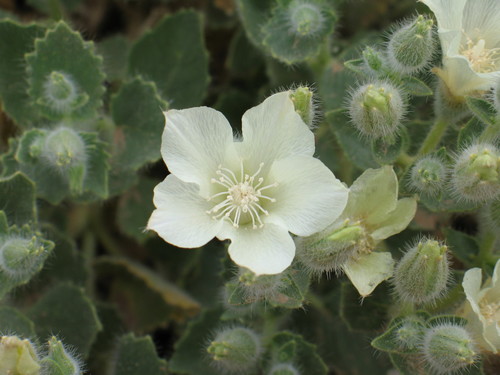


Desert Rock Nettle
eucnide urens
The Desert Rock Nettle (Eucnide urens) is a fascinating, resilient perennial subshrub native to the arid desert regions of the southwestern United States and northern Mexico. Clinging tenaciously to dry, vertical limestone cliffs and rocky canyon walls, this plant has adapted perfectly to some of the harshest environments on Earth. While it appears soft and velvety from a distance, it is covered in highly irritant, stinging hairs that warn away herbivores. In the spring, it transforms its rugged surroundings by producing highly delicate, cream-to-yellow colored, bell-shaped flowers with bursts of dramatic, thread-like stamens. This striking contrast between its hostile defenses and beautiful blooms makes it a highlight for hikers and botanists exploring desert canyons. It serves as an ecological anchor on steep slopes, helping prevent erosion and offering resources to hardy desert pollinators.
Hábitat: Found on steep, rocky canyon walls, talus slopes, and creosote scrub deserts, often clinging to dry limestone cliffs.
This species grows as a rounded, bushy clump measuring 30 to 60 centimeters in height and width. Its leaves are light green, rounded, and coarsely toothed, with a textured surface covered in a dense coat of glistening, Velcro-like, and stinging hairs. The most prominent feature is its bell-shaped flowers, which are pale cream to greenish-yellow, measuring 2 to 5 centimeters across. A dramatic cluster of numerous long, creamy-white stamens extends far beyond the petals, giving each bloom a delicate, starburst appearance. Stems are woody at the base, transition to herbaceous light-green branches, and are similarly covered in defensive trichomes.
Categoría
PlantasRareza
Common
Peligro
1/5 · Muy bajo
Snaps
¡Sé la primera persona en hacer un snap!
Despite its name, the Desert Rock Nettle is not a true nettle but belongs to the Loasaceae family, commonly known as the rock nettle or stickleaf family.
Its stinging hairs can inject a potent chemical cocktail that causes a burning sensation lasting for several hours.
The leaves are covered in microscopic barbed hairs that act exactly like Velcro, allowing parts of the plant to hitchhike on clothing or animal fur.
The plant is covered in specialized, brittle hairs that act like hypodermic needles, injecting painful, irritating chemicals into herbivores upon the slightest contact.
Its tough, deep-reaching root system can penetrate micro-crevices in solid rock faces, securing the plant against gravity and extracting hidden moisture.
The dense coating of white hairs reflects intense desert solar radiation, lowering leaf temperatures and reducing water loss through transpiration.
As a photoautotrophic plant, it synthesizes all its necessary nutrients and energy from sunlight, water, and carbon dioxide via photosynthesis.
Ovis canadensis nelsoni
Rarely browsed by desert bighorn sheep when food is scarce, despite the plant's painful stinging hairs.
Apis mellifera
Visits the large, pollen-rich cream flowers during spring, acting as an effective pollinating agent.
Aún no hay insignias de rasgos asignadas a este objeto.
Todavía no hay alias listados.
Las colecciones para este objeto aparecerán aquí a medida que se añadan más temas.
Peligro
1/5 · Muy bajo
Todavía no hay notas especiales de seguridad.
La forma más fácil de identificar a Desert Rock Nettle es usar la aplicación de identificación de naturaleza Snappit.
30-60 cm
2-10 años
As a photoautotrophic plant, it synthesizes all its necessary nutrients and energy from sunlight, water, and carbon dioxide via photosynthesis.
Found on steep, rocky canyon walls, talus slopes, and creosote scrub deserts, often clinging to dry limestone cliffs.
Acércate para separar los grupos y explorar dónde se ha fotografiado este objeto.
Los snaps recientes aparecerán aquí a medida que se añadan nuevas observaciones.








