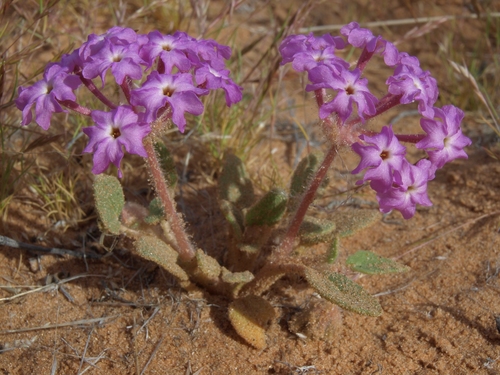


Desert Sand Verbena
abronia villosa
The Desert Sand Verbena (Abronia villosa) is a charming annual herbaceous plant native to the arid and semi-arid regions of southwestern North America. Known for its vibrant, fragrant flowers and its ability to thrive in challenging sandy environments, this plant is a resilient beauty of the desert landscape. It plays a crucial ecological role in stabilizing shifting sands and providing nectar for various desert pollinators, making it an essential component of its delicate ecosystem. Its short but spectacular life cycle, often triggered by seasonal rains, brings a splash of color to otherwise stark environments, symbolizing the surprising biodiversity found in desert habitats.
Hábitat: Found thriving in sandy soils, including desert dunes, sandy washes, and coastal dunes, where it can anchor itself in shifting substrates.
The Desert Sand Verbena is a low-growing, sprawling annual herb, typically forming mats up to 1 meter (3 feet) in diameter. Its stems are often reddish, fleshy, and somewhat hairy (villous), bearing succulent, oval to roundish leaves that are also pubescent. The most striking feature is its dense, globe-shaped clusters of small, trumpet-shaped flowers, which range in color from bright pink to magenta or rose-purple. These vibrant flower heads are often several centimeters across and stand out against the sandy substrate.
Categoría
PlantasRareza
Common
Peligro
1/5 · Muy bajo
Snaps
¡Sé la primera persona en hacer un snap!
Despite its common name "verbena," it is not related to true verbenas (family Verbenaceae) but belongs to the Nyctaginaceae family, also known as the "four o'clock" family.
Historically, some Indigenous groups in its native range used parts of the plant for traditional medicinal purposes, such as treating skin irritations.
Its beautiful flowers are often among the first to bloom after significant desert rainfall, bringing a sudden splash of color to the otherwise barren landscape.
The species name "villosa" refers to the plant's velvety, hairy (villous) stems and leaves, a common adaptation to reduce water loss in arid environments.
Its succulent leaves and fleshy stems allow it to store water, enabling survival in extremely arid conditions typical of desert environments.
Its sprawling growth habit and robust root system help to bind loose sand, playing a role in stabilizing dunes and preventing erosion.
The flowers emit a strong, sweet fragrance at night, specifically adapted to attract nocturnal pollinators like hawk moths in the desert.
As a photosynthetic organism, Desert Sand Verbena produces its own food by converting sunlight, water, and carbon dioxide into sugars, primarily relying on nutrients absorbed from the sandy soil.
Hyles lineata
A primary pollinator attracted by its nocturnal fragrance.
Sylvilagus audubonii
Feeds on the leaves and stems, acting as an herbivore.
Dipodomys spp.
Seeds are a food source for various desert rodents.
Larrea tridentata
May grow alongside and compete for resources in sandy habitats.
Aún no hay insignias de rasgos asignadas a este objeto.
Todavía no hay alias listados.
Las colecciones para este objeto aparecerán aquí a medida que se añadan más temas.
Peligro
1/5 · Muy bajo
Todavía no hay notas especiales de seguridad.
La forma más fácil de identificar a Desert Sand Verbena es usar la aplicación de identificación de naturaleza Snappit.
30-100 cm
0.05-0.5 kg
0-1 años
As a photosynthetic organism, Desert Sand Verbena produces its own food by converting sunlight, water, and carbon dioxide into sugars, primarily relying on nutrients absorbed from the sandy soil.
Found thriving in sandy soils, including desert dunes, sandy washes, and coastal dunes, where it can anchor itself in shifting substrates.
Photosynthesis
50-500
Acércate para separar los grupos y explorar dónde se ha fotografiado este objeto.
Los snaps recientes aparecerán aquí a medida que se añadan nuevas observaciones.