

Devil'S Urn
urnula craterium
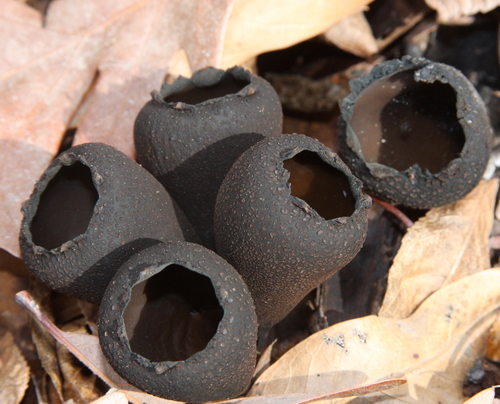
The Devil's Urn (Urnula craterium) is a fascinating early spring fungus easily recognized by its distinctive, dark, cup-like appearance. Resembling a charred, leathery goblet sprouting from the forest floor, it is often one of the first macrofungi to emerge after the snow melts. For avid mushroom foragers, spotting a Devil's Urn is a moment of excitement, as it acts as a classic phenological indicator that the prized morel mushroom season is just around the corner. Ecologically, this fungus lives a double life. It begins as a weak parasite on living oak trees, causing a disease known as Strumella canker, before transitioning into a saprobe that feeds on the dead, decaying hardwood. Its striking appearance and unique life cycle make it a captivating find for nature enthusiasts exploring early spring woodlands.
Hábitat: Found in temperate hardwood forests, particularly on or near decaying oak logs, buried branches, and fallen timber.
The Devil's Urn forms a deep, cup-shaped or urn-like fruiting body that typically measures 4 to 8 centimeters in height and 3 to 4 centimeters wide. Its exterior is dark brownish-black with a slightly fuzzy or scaly texture, while the spore-bearing interior surface is smooth and jet black. As the fungus matures, the rim of the cup often splits, tearing into ragged, star-like margins. It is attached to the substrate by a short, tough, and sometimes buried stalk, giving it the appearance of a dark chalice resting directly on the leaf litter.
Categoría
HongosRareza
Common
Peligro
1/5 · Muy bajo
Snaps
¡Sé la primera persona en hacer un snap!
Despite its eerie name and black, charred appearance, the fungus is entirely harmless to humans, though it is considered inedible due to its tough, leathery texture.
Foraging enthusiasts often affectionately call the Devil's Urn a 'morel indicator' because its appearance signals that prized morel mushrooms will soon begin to fruit.
If you gently blow on a mature Devil's Urn, the change in air flow can trigger the fungus to release a visible, smoke-like puff of spores.
It causes a disease called Strumella canker in living oak trees, which produces a distinctive target-shaped wound on the tree's bark.
When exposed to a sudden change in air pressure or a gust of wind, the mature cup can forcibly eject its spores in a visible cloud resembling smoke.
Fruiting in early spring, this tough fungus can survive sudden frosts and freezes, pausing its growth until temperatures rise again.
It seamlessly switches between a parasitic phase on living trees to a saprobic phase decomposing the very same wood once it dies.
The Devil's Urn extracts nutrients by breaking down the complex lignins and celluloses of dead or dying hardwood trees.
Diferencias por edad: Transitions from a weak parasite on living oaks to a saprobe decomposing dead wood.
Collembola
Serves as a host and food source for tiny early spring mycophagous arthropods.
Quercus alba
Parasitizes and later decomposes the wood of specific hardwood trees.
Morchella esculenta
Shares the same microhabitat and early spring fruiting triggers, acting as an indicator species for foragers.
Aún no hay insignias de rasgos asignadas a este objeto.
Todavía no hay alias listados.
Las colecciones para este objeto aparecerán aquí a medida que se añadan más temas.
Peligro
1/5 · Muy bajo
Todavía no hay notas especiales de seguridad.
La forma más fácil de identificar a Devil'S Urn es usar la aplicación de identificación de naturaleza Snappit.
4-8 cm
0.005-0.015 kg
1-10 años
The Devil's Urn extracts nutrients by breaking down the complex lignins and celluloses of dead or dying hardwood trees.
Found in temperate hardwood forests, particularly on or near decaying oak logs, buried branches, and fallen timber.
Mycelial Expansion
Acércate para separar los grupos y explorar dónde se ha fotografiado este objeto.
Los snaps recientes aparecerán aquí a medida que se añadan nuevas observaciones.