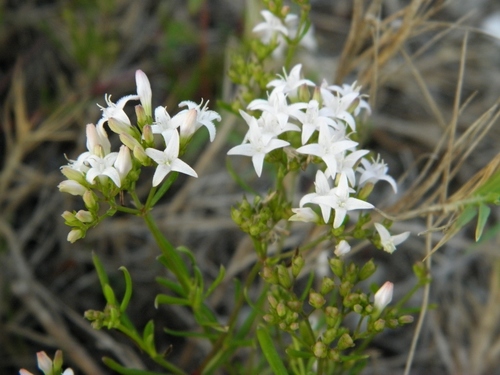


Diamond-Flowers
stenaria nigricans
Diamond-Flowers (Stenaria nigricans), also widely known as narrowleaf bluets, are hardy perennial herbs native to North America. Flourishing in sunny, barren landscapes such as limestone glades, rocky prairies, and thin-soiled outcroppings, these resilient wildflowers add delicate beauty to harsh environments. They are members of the madder family (Rubiaceae), characterized by clusters of tiny, pale white to pink or lavender star-shaped flowers that bloom from late spring through autumn. These low-profile plants play an essential ecological role by stabilizing thin rocky soils and providing a critical nectar source for native pollinators, including small bees and butterflies. Despite their fragile appearance, Diamond-Flowers possess a robust, woody taproot that allows them to withstand intense drought and extreme heat, making them a testament to botanical resilience in challenging habitats.
Hábitat: Found in dry, open habitats with alkaline soils, particularly limestone glades, rocky prairies, barrens, and thin-soiled bluffs.
Diamond-Flowers typically grow as slender, multi-stemmed clumps reaching 10 to 50 centimeters in height. The stems are wiry, erect, and lined with narrow, opposite, needle-like linear leaves that measure up to 4 centimeters long. The defining feature is the dense, terminal clusters of small, four-lobed flowers. These star-shaped corollas range in color from pure white to pale pink or lavender, often featuring protruding stamens and styles. A unique identifying characteristic of this species is that its foliage turns a distinctively dark, almost black color when dried or when the plant dies.
Categoría
PlantasRareza
Common
Peligro
1/5 · Muy bajo
Snaps
¡Sé la primera persona en hacer un snap!
Despite being delicate in appearance, they are tough pioneer plants capable of growing directly out of cracks in solid limestone bedrock.
Its flowers are dimorphic (having two forms with differing style lengths), an evolutionary adaptation that prevents self-pollination and encourages genetic diversity.
The specific epithet 'nigricans' means 'becoming black', referring to how the plant's leaves and stems turn jet black when dried or pressed.
Possesses a deep, woody taproot that penetrates cracks in solid limestone bedrock to access moisture during hot, dry summer months.
Accumulates chemical compounds that cause the leaves and stems to turn starkly black upon drying, which may deter post-mortem herbivory.
Thrives in highly alkaline, calcium-rich soils where many other competing plant species struggle to survive due to nutrient locking.
As a photosynthetic plant, it generates its own energy from sunlight, water, and carbon dioxide while absorbing essential minerals from alkaline limestone soils.
Bombus pensylvanicus
Polinated by native bumblebees searching for nectar in glade environments.
Lasioglossum vierecki
Small sweat bees visit the flowers to forage on pollen and nectar.
Odocoileus virginianus
Occasionally grazes on the foliage, though the plant is relatively resistant to light herbivory.
Aún no hay insignias de rasgos asignadas a este objeto.
Todavía no hay alias listados.
Las colecciones para este objeto aparecerán aquí a medida que se añadan más temas.
Peligro
1/5 · Muy bajo
Todavía no hay notas especiales de seguridad.
La forma más fácil de identificar a Diamond-Flowers es usar la aplicación de identificación de naturaleza Snappit.
10-50 cm
2-8 años
As a photosynthetic plant, it generates its own energy from sunlight, water, and carbon dioxide while absorbing essential minerals from alkaline limestone soils.
Found in dry, open habitats with alkaline soils, particularly limestone glades, rocky prairies, barrens, and thin-soiled bluffs.
Acércate para separar los grupos y explorar dónde se ha fotografiado este objeto.
Los snaps recientes aparecerán aquí a medida que se añadan nuevas observaciones.




_(4575518939).jpg&width=800)




.jpg&width=800)


.JPG&width=800)



.jpg&width=800)
