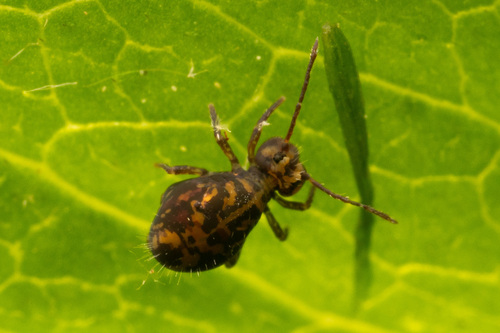
Dicyrtomina Ornata
dicyrtomina ornata
La Dicyrtomina Ornata es un diminuto y fascinante colémbolo que le encanta saltar por el suelo. ¡Ayudan a mantener la tierra sana al descomponer materiales en descomposición!
Hábitat: Suelo húmedo y hojarasca en bosques y jardines.
La Dicyrtomina Ornata es un colémbolo diminuto y globular, lo que significa que tiene una forma corporal distintivamente redonda. Típicamente exhibe un hermoso patrón de amarillo o naranja con marcas y bandas oscuras, a menudo parduscas o negras. Su forma esférica la hace destacar visualmente de muchas otras especies de colémbolos alargados.
Categoría
InvertebrateRareza
Common
Peligro
0/5 · Sin peligro conocido
Snaps
2
¿Sabías que los colémbolos son uno de los animales más numerosos de la Tierra?
¡Los colémbolos usan un 'tubo ventral' especial para ayudarles a absorber agua!
¡Estos diminutos saltadores existen desde hace más de 400 millones de años!
¡Pueden sobrevivir temperaturas bajo cero produciendo un anticongelante natural!
¡Comen pequeños trozos de plantas y hongos en descomposición, ayudando a reciclar nutrientes!
Los animales solitarios viven solos durante la mayor parte de su vida y solo interactúan con otros para aparearse o cuidar de sus crías.
Colorido describe a organismos u objetos que exhiben una amplia variedad de colores brillantes y distintivos.
Los animales excavadores cavan túneles y cámaras en el suelo y utilizan estas estructuras subterráneas para refugiarse, cazar o reproducirse.
Describe a los organismos que descomponen la materia orgánica muerta, reciclando los nutrientes de vuelta al ecosistema.

Los hábitats acuáticos abarcan entornos donde los organismos viven principalmente en el agua, incluidos océanos, ríos, lagos y humedales.
Peligro
0/5 · Sin peligro conocido
Todavía no hay notas especiales de seguridad.
La forma más fácil de identificar a Dicyrtomina Ornata es usar la aplicación de identificación de naturaleza Snappit.
1.5 mm
6 meses
¡Comen pequeños trozos de plantas y hongos en descomposición, ayudando a reciclar nutrientes!
Suelo húmedo y hojarasca en bosques y jardines.
Recolección
15 cm
Acércate para separar los grupos y explorar dónde se ha fotografiado este objeto.
22 may 2026
CheshamFuente abierta (iNaturalist) ↗
Créditos de la foto
(c) Jack Forrester, some rights reserved (CC BY)
Licencia: CC BY 4.0 ↗
La imagen puede mostrarse recortada dentro del marco de la carta.

New Hampshire, US
Puedes ver Salamandra De Dorso Rojo Oriental y Tritón Oriental.
Ver guía →

Massachusetts, US
Puedes ver Leopardo De Las Nieves, Jaguar y Canis Lupus Baileyi.
Ver guía →

Washington, US
Puedes ver Araña De Jardín Con Cruz, Pato y Epilobio Ciliado.
Ver guía →
Llévate el descubrimiento
Haz una foto con Snappit, identifica la especie y guarda el hallazgo en tu colección.