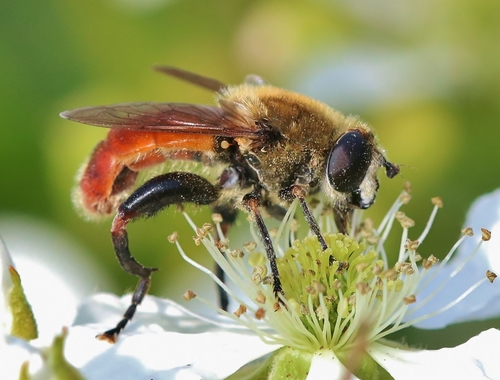


Dimorphic Sickleleg
polydontomyia curvipes
The Dimorphic Sickleleg (Polydontomyia curvipes) is a fascinating species of hoverfly renowned for its remarkable structural adaptations and exceptional flight capabilities. As its common name suggests, this species exhibits striking sexual dimorphism, with males possessing dramatically curved, sickle-shaped hind legs that play a crucial role in reproduction and territorial defense. While they might look intimidating due to their bold, wasp-like coloration, these insects are entirely harmless and lack a stinger. Instead, they serve as vital pollinators in their native ecosystems. Found primarily in North American coastal and inland wetlands, they represent a wonderful example of Batesian mimicry and insect specialization. Spotting one of these agile flyers hovering precisely over a salt marsh blossom is a rewarding experience for any nature enthusiast.
Hábitat: Primarily inhabits coastal salt marshes, brackish estuaries, and inland saline wetlands throughout North America.
This medium-sized hoverfly measures roughly 1 to 1.5 centimeters in length and features a classic Batesian mimicry pattern with striking yellow and black bands across its abdomen, closely resembling a wasp or bee. The most distinctive visual trait is found in the males, which sport robust, highly bowed or sickle-shaped hind tibiae and femora, giving them a slightly bow-legged appearance in flight or at rest. Females lack these curved legs and have more standard, straight hind limbs. Both sexes possess large, reddish-brown compound eyes that cover most of the head, and a pair of clear, iridescent wings that span up to 2.5 centimeters.
Categoría
InsectosRareza
Common
Peligro
1/5 · Muy bajo
Snaps
¡Sé la primera persona en hacer un snap!
Despite their menacing wasp-like appearance, Dimorphic Sicklelegs are completely harmless and do not possess a stinger.
The scientific name 'curvipes' literally translates to 'curved foot,' a nod to the male's dramatically bowed hind legs.
Their larvae are among the few insects adapted to thrive in the harsh, highly saline environments of coastal salt marshes.
Mimics the striking yellow and black warning coloration of stinging wasps and bees to successfully deter potential predators.
Males possess highly specialized, curved hind legs used for grasping females securely during mating and fending off rival males.
Capable of perfectly stable, stationary flight in mid-air, allowing them to carefully inspect flowers and easily evade predators.
Adults feed exclusively on nectar and pollen, while the aquatic larvae consume decaying organic matter and microorganisms.
Diferencias por edad: Larvae are aquatic detritivores filtering organic matter, whereas adults are flying nectarivores.
Solidago sempervirens
Adults frequently visit and pollinate this coastal plant.
Hirundo rustica
Caught in mid-air by agile insectivorous birds.
Aedes taeniorhynchus
Larvae share brackish aquatic habitats and compete for detritus.
Aún no hay insignias de rasgos asignadas a este objeto.
Todavía no hay alias listados.
Las colecciones para este objeto aparecerán aquí a medida que se añadan más temas.
Peligro
1/5 · Muy bajo
Todavía no hay notas especiales de seguridad.
La forma más fácil de identificar a Dimorphic Sickleleg es usar la aplicación de identificación de naturaleza Snappit.
1-2 cm
1-3 cm
0.00005-0.0001 kg
0 años
12 km/h
Adults feed exclusively on nectar and pollen, while the aquatic larvae consume decaying organic matter and microorganisms.
Primarily inhabits coastal salt marshes, brackish estuaries, and inland saline wetlands throughout North America.
Acércate para separar los grupos y explorar dónde se ha fotografiado este objeto.
Los snaps recientes aparecerán aquí a medida que se añadan nuevas observaciones.












