

Douglas' Violet
viola douglasii
Douglas' Violet, also known as the golden violet, is a striking perennial wildflower native to the West Coast of North America. Renowned for its brilliant golden-yellow blooms and uniquely textured foliage, this resilient plant thrives in harsh environments where many others cannot, such as rocky, heavy-metal-rich serpentine soils. Belonging to the diverse violet family, it is a quintessential harbinger of spring in California's oak woodlands, chaparral, and grassy meadows. Beyond its visual charm, Douglas' Violet plays a crucial role in local ecosystems by serving as a vital host plant for the caterpillars of beautiful fritillary butterflies. Its ability to thrive in challenging landscapes makes it a fascinating subject of botanical study and a joy for native plant enthusiasts to discover.
Hábitat: Found in open, grassy slopes, chaparral, oak woodlands, and meadows, frequently thriving in specialized, rocky serpentine soils.
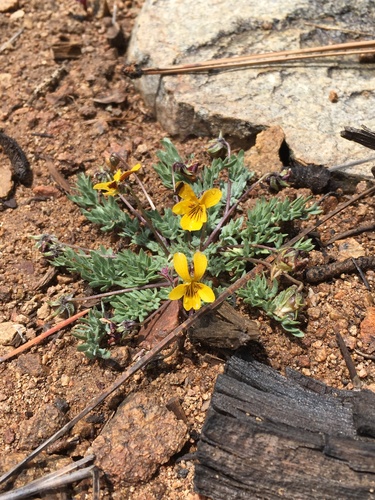
This low-growing herbaceous plant typically reaches 5 to 20 centimeters in height. Its most distinguishing feature is its deeply dissected, almost fern-like green leaves, which set it apart from the typical broad, heart-shaped leaves of most other violets. The vibrant yellow flowers are held on slender stems and feature five petals. The lower three petals are prominently marked with intricate brownish-purple veins that act as nectar guides, while the backs of the two upper petals often possess a deep reddish-brown or purplish hue.
Categoría
PlantasRareza
Common
Peligro
1/5 · Muy bajo
Snaps
¡Sé la primera persona en hacer un snap!
It was named in honor of David Douglas, a famous 19th-century Scottish botanist who extensively explored the flora of the Pacific Northwest and California.
Its seeds have a small, fatty appendage called an elaiosome, which attracts ants that carry the seeds away, indirectly planting them in new locations.
The reddish-brown veins on its lower petals act like an airport runway, guiding insect pollinators straight to the hidden nectar source.
Unlike the classic heart-shaped leaves of most violets, Douglas' Violet has leaves that are deeply lobed and divided, resembling miniature ferns.
Thrives in harsh, rocky soils that are notoriously low in essential nutrients and high in toxic heavy metals like magnesium and iron.
Produces secondary, bud-like flowers later in the season that never open, pollinating themselves to ensure seed production even if insects are absent.
Evades severe summer droughts by dying back to its robust underground taproot, lying dormant until it resprouts with the winter rains.
As a photosynthetic plant, Douglas' Violet creates its own food by converting sunlight, water, and atmospheric carbon dioxide into energy.
Speyeria callippe
Provides essential foliage for the caterpillars of the Callippe Fritillary butterfly to consume.
Osmia lignaria
Native bees visit the open early-season flowers to forage for nectar and pollen, aiding in cross-pollination.
Aún no hay insignias de rasgos asignadas a este objeto.
Todavía no hay alias listados.
Las colecciones para este objeto aparecerán aquí a medida que se añadan más temas.
Peligro
1/5 · Muy bajo
Todavía no hay notas especiales de seguridad.
La forma más fácil de identificar a Douglas' Violet es usar la aplicación de identificación de naturaleza Snappit.
5-20 cm
2-10 años
As a photosynthetic plant, Douglas' Violet creates its own food by converting sunlight, water, and atmospheric carbon dioxide into energy.
Found in open, grassy slopes, chaparral, oak woodlands, and meadows, frequently thriving in specialized, rocky serpentine soils.
Photosynthesis
10-40
14-30 días
Acércate para separar los grupos y explorar dónde se ha fotografiado este objeto.
Los snaps recientes aparecerán aquí a medida que se añadan nuevas observaciones.