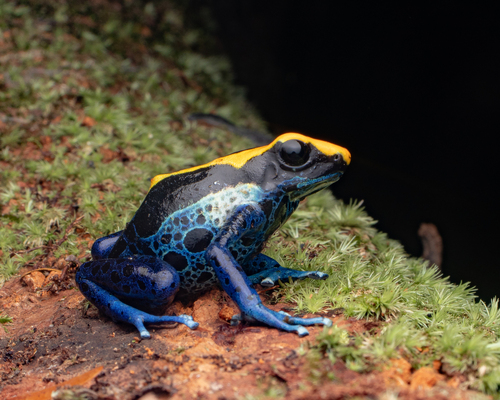


Dyeing Poison Dart Frog
dendrobates tinctorius
The Dyeing Poison Dart Frog (Dendrobates tinctorius) is a breathtakingly vibrant amphibian native to the dense rainforests of the Guiana Shield in South America. Among the largest of the poison dart frogs, it is famous for its dazzling, high-contrast coloration, which serves as a stark warning to predators about its potent toxicity. This frog's scientific name, 'tinctorius', originates from indigenous legends claiming that tribes used the frog's skin secretions to artificially dye the feathers of young parrots. Despite its dangerous reputation in the wild, the frog's toxicity is entirely derived from its diet of specialized rainforest insects. When bred in captivity and fed standard terrarium diets, they are completely harmless. This combination of stunning beauty, complex parental care behavior where males carry tadpoles to water pools on their backs, and fascinating biochemistry makes it one of the most iconic amphibians in the world.
Hábitat: Typically found foraging in the humid leaf litter and among the roots of the dense, primary lowland rainforests of the Guiana Shield.
Dendrobates tinctorius is highly polymorphic, meaning its appearance varies drastically depending on the specific region it comes from, though it generally features a glossy, smooth skin. The most common pattern consists of a deep black background overlaid with irregular, vibrant yellow or white stripes and spots along the back and head, often paired with stunning cobalt blue or dark blue legs dotted with black. One famous variation, formerly considered a separate species (D. azureus), is entirely sky blue with black spots. They are robust, relatively large dart frogs, typically measuring between 3.5 and 5 centimeters in length, with distinctive, unwebbed toes equipped with small adhesive pads for climbing.
Categoría
AnfibiosRareza
Common
Peligro
1/5 · Muy bajo
Snaps
¡Sé la primera persona en hacer un snap!
A famous solid-blue variation of this frog was once thought to be an entirely different species called the Azureus Poison Dart Frog before genetic testing proved them identical.
Indigenous tribes allegedly used the frog's skin secretions to change the natural color of growing parrot feathers, a process called 'tapirage', which inspired the frog's name 'tinctorius' meaning 'used for dyeing'.
Unlike most frogs that lay hundreds of eggs in ponds, this species lays only a few eggs on dry land, and the father carries the hatched tadpoles piggyback-style to water.
When kept in captivity and fed standard insects like fruit flies, they completely lose their toxicity, proving their poison comes purely from their natural diet.
The frog extracts and stores highly toxic lipophilic alkaloids from its diet of wild ants and mites, secreting them through its skin as a defense mechanism.
It displays brilliant, contrasting colors that act as a visual warning signal to potential predators that it is highly toxic and unpalatable.
After the eggs hatch in terrestrial nests, the male frog uses a specialized sticky mucus to carry the tadpoles on his back to small pools of water in plants.
In the wild, they consume a specialized diet of tiny, alkaloid-rich invertebrates, which they actively hunt in the leaf litter.
Diferencias por edad: Tadpoles are omnivorous, feeding on algae, detritus, and sometimes unfertilized eggs, while adults are strict insectivores.
Neoregelia carolinae
Provides vital microhabitats and pools of water for the frog's developing tadpoles.
Solenopsis spp.
A primary food source in the wild, providing the chemical compounds the frog uses to produce toxins.
Erythrolamprus epinephelus
One of the few predators known to be highly resistant to the powerful toxins of poison dart frogs.
Aún no hay insignias de rasgos asignadas a este objeto.
Las colecciones para este objeto aparecerán aquí a medida que se añadan más temas.
Peligro
1/5 · Muy bajo
Todavía no hay notas especiales de seguridad.
La forma más fácil de identificar a Dyeing Poison Dart Frog es usar la aplicación de identificación de naturaleza Snappit.
3-5 cm
0.003-0.008 kg
10-15 años
In the wild, they consume a specialized diet of tiny, alkaloid-rich invertebrates, which they actively hunt in the leaf litter.
Typically found foraging in the humid leaf litter and among the roots of the dense, primary lowland rainforests of the Guiana Shield.
Foraging
4-14
Acércate para separar los grupos y explorar dónde se ha fotografiado este objeto.
Los snaps recientes aparecerán aquí a medida que se añadan nuevas observaciones.