

Eastern Mudsnail
ilyanassa obsoleta
The Eastern Mudsnail is a small, ubiquitous marine gastropod that plays an incredibly vital role in coastal ecosystems. Found blanketing mudflats and estuaries, these highly social snails gather in dense herds to scavenge and feed, serving as nature's tiny clean-up crew. Their collective feeding action helps aerate the mud and recycle organic nutrients back into the ecosystem, supporting a wide range of marine life. Though they may seem simple, these resilient snails possess sophisticated chemical sensors that help them navigate their muddy habitats. They are also known for their complex relationship with parasites, acting as hosts to several species of flatworms that eventually infect shorebirds, making them a fascinating subject for ecological study.
Hábitat: Found in sheltered intertidal mudflats, estuaries, and salt marshes, often where organic debris is abundant.
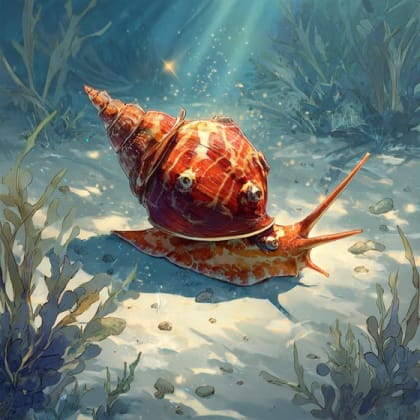
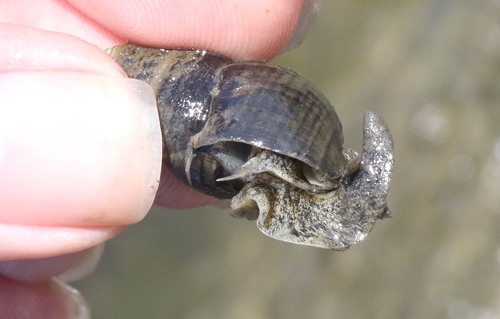
Measuring up to 3 centimeters in length, the Eastern Mudsnail has a dark brown to nearly black, conical shell adorned with fine spiral lines. The tip or apex of the shell is frequently eroded, revealing a contrasting chalky white or gray underlying layer. When active, the snail extends a soft, grayish-mottled foot and two long, slender tentacles used to probe its surroundings.
Categoría
InvertebrateRareza
Common
Peligro
1/5 · Muy bajo
Snaps
¡Sé la primera persona en hacer un snap!
Eastern mudsnails can gather in massive densities, sometimes exceeding 10,000 snails in a single square meter of mud.
Their shells are frequently colonized by other organisms, such as tiny sea anemones or algae, turning them into walking mini-ecosystems.
When the tide rises, they often burrow completely into the mud, reappearing in massive numbers as soon as the water recedes.
When injured, the snail releases a chemical alarm pheromone that warns nearby mudsnails, triggering them to burrow rapidly into the sediment for safety.
It uses specialized chemoreceptors to detect and follow the slimy trails left by other mudsnails, allowing them to gather in large groups for feeding or mating.
Despite living in acidic, abrasive mud that wears away the outer protective layer of its shell, the snail maintains a thick, durable inner shell structure.
The Eastern Mudsnail is primarily a scavenger and detritivore, vacuuming up benthic microalgae, organic debris, and decaying animal matter.
Diferencias por edad: Juveniles rely heavily on microscopic algae coating the mud, while mature adults consume more diverse animal detritus and decaying organic material.
Callinectes sapidus
Preys heavily on mudsnails, cracking open their shells.
Gynaecotyla adunca
Uses the mudsnail as an intermediate host in its complex life cycle.
Aún no hay insignias de rasgos asignadas a este objeto.
Todavía no hay alias listados.
Las colecciones para este objeto aparecerán aquí a medida que se añadan más temas.
Peligro
1/5 · Muy bajo
Todavía no hay notas especiales de seguridad.
La forma más fácil de identificar a Eastern Mudsnail es usar la aplicación de identificación de naturaleza Snappit.
1-3 cm
0.001-0.005 kg
3-10 años
The Eastern Mudsnail is primarily a scavenger and detritivore, vacuuming up benthic microalgae, organic debris, and decaying animal matter.
Found in sheltered intertidal mudflats, estuaries, and salt marshes, often where organic debris is abundant.
Foraging
20-200
Acércate para separar los grupos y explorar dónde se ha fotografiado este objeto.
Los snaps recientes aparecerán aquí a medida que se añadan nuevas observaciones.




_(14534156278).jpg&width=800)