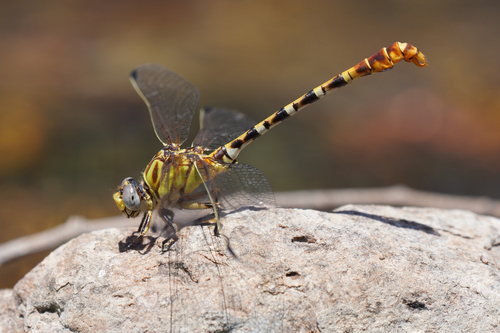


Eastern Ringtail
erpetogomphus designatus
The Eastern Ringtail (Erpetogomphus designatus) is a captivating member of the clubtail dragonfly family. Renowned for its striking coloration and active behaviors, this species is commonly found near fast-flowing rivers and rocky streams throughout the central and southern United States. Unlike many other dragonflies that hang from vegetation, the Eastern Ringtail is famous for its habit of perching flat on sunny rocks, sandbars, or gravelly shores. It is an efficient and agile aerial predator, serving as a vital indicator of healthy aquatic ecosystems due to its sensitive larval stage. Watching one of these bright insects dart over water on a sunny day is a true highlight for nature enthusiasts.
Hábitat: Found along sandy, gravelly, or rocky banks of medium-to-large rivers and fast-flowing streams.
This medium-sized dragonfly features a vibrant olive-green to bright yellow-green thorax marked with elegant dark brown or black stripes. Its abdomen is slender, patterned with alternating dark rings and pale spots, and terminates in a slightly swollen, flared 'club' shape characteristic of its family. Its wings are completely clear with highly detailed, dark venation and a wingspan reaching up to 7 centimeters. Its most defining facial feature is its widely separated, brilliant green or blue-green eyes, which do not meet at the top of the head like other dragonfly species.
Categoría
InsectosRareza
Common
Peligro
1/5 · Muy bajo
Snaps
¡Sé la primera persona en hacer un snap!
The Eastern Ringtail belongs to the clubtail family, named for the distinctive swollen segment at the very end of their abdomen.
They are highly dependent on solar heat and are rarely seen active on overcast, windy, or cool days.
Unlike most other dragonfly families whose eyes touch at the top of the head, clubtails have widely separated eyes.
Unlike other dragonfly families that cling to vertical stems, this species is specially adapted to perch horizontally on flat, sun-baked rocks or gravel, matching its body temperature to the substrate.
During its aquatic nymph stage, it uses a modified, high-speed extendable lower lip to seize prey from the muddy riverbed.
Can move each of its four wings independently, allowing it to hover, fly backward, and change direction in a fraction of a second to catch prey.
An opportunistic carnivore that captures a wide variety of flying insects in mid-air, while its aquatic nymphs feed on soft-bodied aquatic larvae.
Diferencias por edad: Nymphs are aquatic ambush predators feeding on aquatic insects, worms, and tiny fish, whereas adults are aerial pursuit predators feeding on flying insects.
Aedes aegypti
Preys upon mosquitoes near riverbanks.
Sayornis phoebe
Preyed upon by flycatching birds along waterways.
Pachydiplax longipennis
Competes for aerial prey and territory in riparian habitats.
Aún no hay insignias de rasgos asignadas a este objeto.
Todavía no hay alias listados.
Las colecciones para este objeto aparecerán aquí a medida que se añadan más temas.
Peligro
1/5 · Muy bajo
Todavía no hay notas especiales de seguridad.
La forma más fácil de identificar a Eastern Ringtail es usar la aplicación de identificación de naturaleza Snappit.
5-6 cm
6-7 cm
0.0001-0.0003 kg
1-2 años
35 km/h
An opportunistic carnivore that captures a wide variety of flying insects in mid-air, while its aquatic nymphs feed on soft-bodied aquatic larvae.
Found along sandy, gravelly, or rocky banks of medium-to-large rivers and fast-flowing streams.
Acércate para separar los grupos y explorar dónde se ha fotografiado este objeto.
Los snaps recientes aparecerán aquí a medida que se añadan nuevas observaciones.
















