

Echium Auberianum
echium auberianum
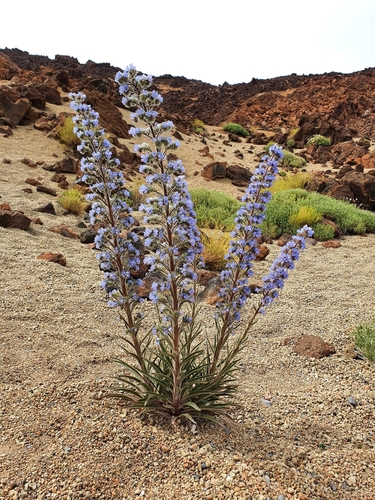
Echium auberianum, commonly known as the blue mountain tajinaste, is a rare and striking plant endemic to the subalpine zones of Tenerife in the Canary Islands. Flourishing in the high-altitude volcanic landscapes of Teide National Park, this botanical marvel spends years as a dense rosette of silver-green leaves before producing a single, monumental flower spike. This dramatic reproductive strategy makes it one of the most iconic and sought-after sights for botanists and hikers alike. Adapted to survive in harsh, arid volcanic soils under intense mountain sunlight, this species acts as a vital resource for high-altitude pollinators. Its spectacular, once-in-a-lifetime bloom showcases nature's resilience and adaptability in extreme conditions.
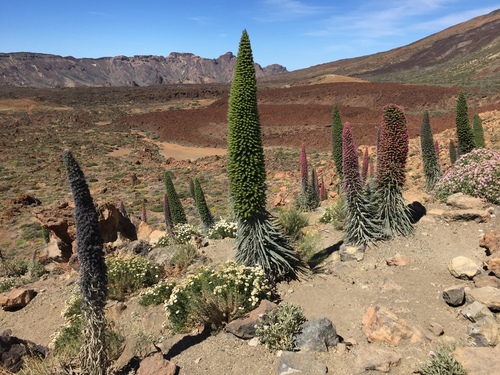
Hábitat: Found on high-altitude volcanic slopes, pumice fields, and rocky screes of the subalpine zone in Teide National Park, Tenerife.
During its vegetative stage, Echium auberianum forms a dense, low-growing rosette of lanceolate, silver-green leaves covered in stiff, white hairs. When it blooms, it erupts into a spectacular, densely packed cylindrical inflorescence reaching 100 to 250 centimeters in height. This towering spike is adorned with thousands of small, trumpet-shaped flowers that transition from pale pink to a soft, pastel blue-violet, accented by protruding red-pink stamens that give the entire spike a fuzzy, vibrant appearance.
Categoría
PlantasRareza
Common
Peligro
1/5 · Muy bajo
Snaps
¡Sé la primera persona en hacer un snap!
Because it grows in incredibly nutrient-poor pumice sand, it relies on deep volcanic mineral extraction to fuel its rapid, massive spring growth spurt.
Its local Spanish name, 'Tajinaste', comes from the Guanche language of Tenerife's original indigenous inhabitants.
This species is monocarpic, meaning it grows patiently for up to a decade as a humble leafy rosette, flowers spectacularly just once, and then dies immediately after setting seed.
Its leaves are densely blanketed in silvery, reflective hairs that block intense high-altitude UV radiation and minimize moisture loss.
It funnels years of stored energy into a single, massive inflorescence to maximize visibility and pollination success in a sparse landscape.
It has evolved a deep, specialized root system capable of anchor stability and nutrient extraction in loose, arid volcanic scree.
It is a photosynthetic plant that utilizes sunlight, water, and atmospheric carbon dioxide to manufacture its own energy.
Bombus canariensis
The Canary Island bumblebee is a crucial pollinator, visiting the thousands of flowers on the giant inflorescence.
Gallotia galloti
The Teide wall lizard feeds on nectar from the flowers and acts as an occasional seed disperser.
Oryctolagus cuniculus
Introduced European rabbits feed heavily on the young rosettes, posing a major threat to its survival.
Aún no hay insignias de rasgos asignadas a este objeto.
Todavía no hay alias listados.
Las colecciones para este objeto aparecerán aquí a medida que se añadan más temas.
Peligro
1/5 · Muy bajo
Todavía no hay notas especiales de seguridad.
La forma más fácil de identificar a Echium Auberianum es usar la aplicación de identificación de naturaleza Snappit.
100-250 cm
3-10 años
It is a photosynthetic plant that utilizes sunlight, water, and atmospheric carbon dioxide to manufacture its own energy.
Found on high-altitude volcanic slopes, pumice fields, and rocky screes of the subalpine zone in Teide National Park, Tenerife.
Acércate para separar los grupos y explorar dónde se ha fotografiado este objeto.
Los snaps recientes aparecerán aquí a medida que se añadan nuevas observaciones.








_3759.JPG&width=800)



_Epilobium_ciliatum_-_flowers.jpg&width=800)




