

Edith'S Checkerspot
euphydryas editha
Edith's Checkerspot (Euphydryas editha) is a fascinating and highly studied butterfly native to western North America. Renowned for its complex population structures and its sensitivity to environmental shifts, this species has become a famous indicator for the ecological impacts of global climate change. With dozens of recognized subspecies—some of which are federally endangered—it occupies a wide range of habitats, from coastal chaparral to alpine meadows. What makes Edith's Checkerspot particularly remarkable is its extreme local specialization. Different populations rely on completely different host plants, leading to a patchwork of highly localized ecotypes. This butterfly exhibits incredible evolutionary agility, sometimes adapting to entirely new introduced host plants within just a few generations, making it a living laboratory for evolutionary biologists.
Hábitat: Found in diverse environments ranging from coastal sage scrub and chaparral to alpine meadows and fell-fields, strictly where their specific larval host plants flourish.
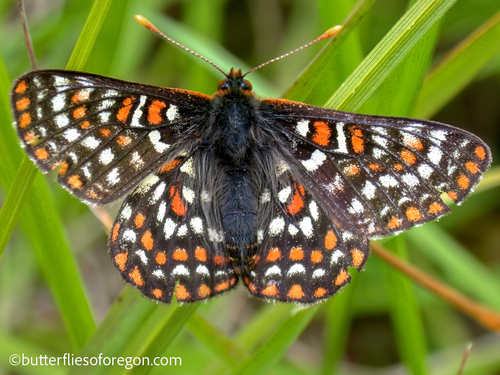
The adult butterfly features a stunning and intricate checkered pattern on its wings, composed of contrasting bands of black, vibrant orange or brick-red, and pale cream or white spots. The dorsal wing surfaces are typically darker with more prominent black outlines separating the colorful cells, while the ventral sides are brighter and more uniformly checkered, aiding in camouflage when the wings are closed. The body is dark, somewhat hairy, and typically measures about 1 to 2 centimeters long, supporting a wingspan that ranges from 3 to 5 centimeters. Subspecies can vary significantly in the exact hue, size, and proportion of red to yellow spots.
Categoría
InsectosRareza
Common
Peligro
1/5 · Muy bajo
Snaps
¡Sé la primera persona en hacer un snap!
Because they are relatively weak fliers, populations often remain highly localized and isolated, which has led to the evolution of over 20 distinct subspecies across their geographic range.
Edith's Checkerspot is one of the most thoroughly studied insects in the context of climate change, providing some of the earliest definitive evidence that species were shifting their ranges in response to a warming planet.
In Nevada, one population of this butterfly completely switched its preferred host plant from a native species to an introduced European weed within just over a decade, showcasing incredibly rapid evolution.
Populations have famously demonstrated geographic range shifts, naturally migrating northward and to higher elevations over decades in response to global warming.
Females possess the remarkable ability to rapidly evolve egg-laying preferences, adapting to invasive or novel host plants in just a few years.
Caterpillars can enter a state of suspended animation known as diapause to survive long, hot, dry summers when their host plants wither away.
Caterpillars are obligate herbivores that feed on specific host plants, while adults are nectarivores that consume liquid nectar from flowering plants.
Diferencias por edad: Larvae strictly consume the foliage of specific host plants, whereas adults transition to consuming liquid nectar from a variety of nearby blooming flowers.
Plantago erecta
Primary larval host plant for many coastal populations.
Castilleja exserta
Primary larval host plant for several montane and southern populations.
Sceloporus occidentalis
Common predator that hunts adult butterflies resting on rocks.
Cotesia spp.
Parasitic wasps that lay their eggs inside the checkerspot's caterpillars.
Aún no hay insignias de rasgos asignadas a este objeto.
Todavía no hay alias listados.
Las colecciones para este objeto aparecerán aquí a medida que se añadan más temas.
Peligro
1/5 · Muy bajo
Todavía no hay notas especiales de seguridad.
La forma más fácil de identificar a Edith'S Checkerspot es usar la aplicación de identificación de naturaleza Snappit.
1-2 cm
3-5 cm
0.0001-0.0005 kg
1 años
15 km/h
Caterpillars are obligate herbivores that feed on specific host plants, while adults are nectarivores that consume liquid nectar from flowering plants.
Found in diverse environments ranging from coastal sage scrub and chaparral to alpine meadows and fell-fields, strictly where their specific larval host plants flourish.
Acércate para separar los grupos y explorar dónde se ha fotografiado este objeto.
Los snaps recientes aparecerán aquí a medida que se añadan nuevas observaciones.

California, US
Puedes ver American Pika, Marmota De Vientre Amarillo y Shasta Blue.
Ver guía →

Washington, US
Puedes ver Ardilla Terrestre De Manto Dorado De Las Cascadas.
Ver guía →

Washington, US
Puedes ver Ardilla Terrestre De Manto Dorado De Las Cascadas.
Ver guía →



_mating_2.jpg&width=800)