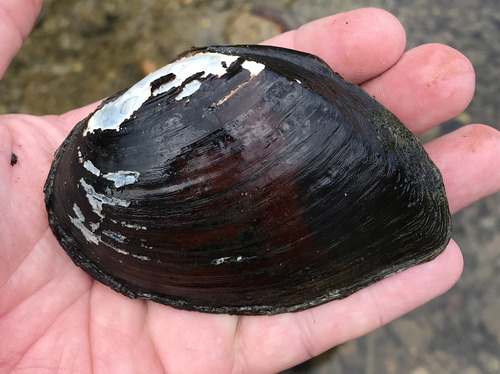


Elephantear
elliptio crassidens
The Elephantear (Elliptio crassidens) is a robust and fascinating freshwater mussel native to the large rivers of the central and eastern United States. Named for its large, heavy, and somewhat triangular shell that resembles the ear of an elephant, this species is a master of anchoring itself in fast-moving river currents. Like other freshwater mussels, it plays a critical role in its aquatic ecosystem by acting as a biological filter, constantly cleaning the water of suspended particulates and algae. The Elephantear is especially notable for its complex life cycle, which relies on a specific host fish to disperse its microscopic larvae, highlighting the intricate biological interconnectedness of healthy river habitats.
Hábitat: Typically found deeply buried in gravel, sand, or stable mud substrates within the main channels of large rivers with moderate to swift currents.
The shell of the Elephantear is exceptionally thick, solid, and roughly triangular to elongated in shape, giving it a massive and weighty feel in the hand. The periostracum (outer shell layer) is typically dark reddish-brown to completely black in adults, though juveniles may exhibit faint green rays. Its defining visual characteristic is its stunning nacre (the inner mother-of-pearl layer), which boasts a vibrant, deep purple to pinkish-purple hue. The shell's hinge features prominent, heavy pseudocardinal and lateral teeth, which help the halves lock tightly together.
Categoría
InvertebrateRareza
Common
Peligro
1/5 · Muy bajo
Snaps
¡Sé la primera persona en hacer un snap!
A single adult Elephantear can filter several gallons of water per day, acting as an unsung hero of river ecosystem purification.
During the pearl button industry boom in the late 19th century, the Elephantear was rejected by button makers because its beautiful deep purple nacre could not be bleached white.
The extreme thickness and weight of its shell allows the Elephantear to survive in river currents that would easily wash lighter mussel species away.
Without the presence of the Skipjack Herring to act as a host for its larvae, the Elephantear cannot reproduce and complete its life cycle.
Filters large volumes of river water daily to extract food, which significantly improves water clarity and overall ecosystem health.
Employs a specialized reproductive strategy where its larvae (glochidia) temporarily attach to the gills of specific host fish to complete their development and travel upstream.
Possesses an exceptionally thick and heavy shell that acts as an anchor, preventing the mussel from being swept away by the powerful currents of large river channels.
As a sedentary filter feeder, the Elephantear continuously siphons river water to extract microscopic organic matter and tiny aquatic organisms.
Diferencias por edad: Larvae (glochidia) are temporarily parasitic and absorb nutrients from the blood of their host fish, whereas adults filter feed independently from the water column.
Alosa chrysochloris
The primary host fish required for the mussel's larvae (glochidia) to develop and disperse.
Ondatra zibethicus
Forages for mussels in shallow riverbeds and frequently leaves shell middens on the banks.
Procyon lotor
Opportunistic predator that extracts mussels from shallow waters during low river levels.
Aún no hay insignias de rasgos asignadas a este objeto.
Todavía no hay alias listados.
Las colecciones para este objeto aparecerán aquí a medida que se añadan más temas.
Peligro
1/5 · Muy bajo
Todavía no hay notas especiales de seguridad.
La forma más fácil de identificar a Elephantear es usar la aplicación de identificación de naturaleza Snappit.
10-16 cm
0.2-0.8 kg
20-50 años
As a sedentary filter feeder, the Elephantear continuously siphons river water to extract microscopic organic matter and tiny aquatic organisms.
Typically found deeply buried in gravel, sand, or stable mud substrates within the main channels of large rivers with moderate to swift currents.
Filtering
20000-95000
Acércate para separar los grupos y explorar dónde se ha fotografiado este objeto.
Los snaps recientes aparecerán aquí a medida que se añadan nuevas observaciones.
Alabama, US
Puedes ver Elephantear, Mejillón De Tres Crestas y Rough Fatmucket.
Ver guía →

Alabama, US
Puedes ver Alabama Orb, Three-Horn Wartyback y Southern Pocketbook.
Ver guía →













_(14271931240).jpg&width=800)





