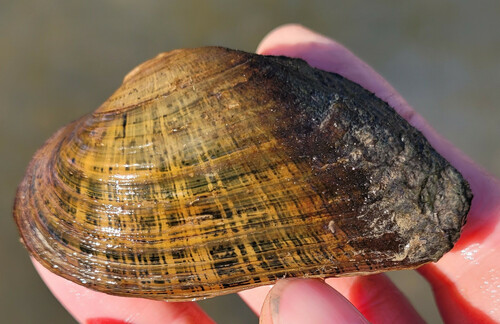


Elktoe
alasmidonta marginata
The Elktoe (Alasmidonta marginata) is a fascinating freshwater mussel, a bivalve mollusk native to the eastern and central United States and parts of Canada. These often-overlooked inhabitants of rivers and streams play a crucial ecological role as natural water filters, contributing significantly to aquatic ecosystem health by removing microscopic particles from the water column. What makes the Elktoe particularly interesting is its unique reproductive strategy, which relies on a temporary parasitic relationship with specific host fish species to disperse its larvae. Its presence often indicates a healthy, stable freshwater environment, making it an important indicator species for aquatic ecosystem quality.
Hábitat: Found in small to medium-sized rivers and streams with stable gravel, sand, or mixed sand-gravel bottoms, typically in areas with moderate to swift currents.
The Elktoe mussel typically has an elongated, somewhat elliptical shell, ranging from yellowish-brown to dark brown, often adorned with radiating green rays that can be more prominent in younger individuals. The shell texture is usually smooth or only slightly sculpted. A distinctive characteristic is the noticeably extended, somewhat flattened posterior margin, giving it a 'toe-like' or 'heel-like' appearance, which lends to its common name. Adults generally measure between 8 to 12 centimeters in length. The interior of the shell is pearly white (nacreous).
Categoría
InvertebrateRareza
Common
Peligro
1/5 · Muy bajo
Snaps
¡Sé la primera persona en hacer un snap!
Elktoe mussels can live for over 20 years, silently cleaning freshwater ecosystems for decades.
The 'elktoe' name comes from the distinctive, flattened posterior end of its shell, which resembles the hoof of an elk.
The larvae (glochidia) of the Elktoe must attach to the gills or fins of specific fish species for a short period to complete their development into juvenile mussels.
These mussels are considered bioindicators; their presence and health can provide insights into the overall ecological health and water quality of a river or stream.
Elktoe mussels are highly efficient filter feeders, continuously drawing water into their siphons and filtering out detritus, bacteria, phytoplankton, and zooplankton, thereby improving water clarity and quality.
Female Elktoes exhibit a remarkable reproductive strategy, displaying a specialized mantle lure that mimics a small fish or insect to attract appropriate host fish. When a fish investigates, the mussel releases glochidia (larvae) that attach to the fish's gills or fins for dispersal.
Equipped with a strong, muscular foot, the Elktoe can burrow and anchor itself securely into the stream bed, allowing it to withstand moderate currents and maintain its position in dynamic aquatic environments.
Elktoe mussels are suspension feeders, filtering microscopic organic particles from the water column. They consume a variety of tiny organisms and decaying matter.
Micropterus dolomieu
Host for larval stage (glochidia) development and dispersal.
Hypentelium nigricans
Host for larval stage (glochidia) development and dispersal.
Lontra canadensis
Potential predator, feeding on mussels when accessible.
Cambarus spp.
Share similar food resources and habitat, may compete with juvenile mussels.
Aún no hay insignias de rasgos asignadas a este objeto.
Todavía no hay alias listados.
Las colecciones para este objeto aparecerán aquí a medida que se añadan más temas.
Peligro
1/5 · Muy bajo
Todavía no hay notas especiales de seguridad.
La forma más fácil de identificar a Elktoe es usar la aplicación de identificación de naturaleza Snappit.
8-12 cm
0.05-0.15 kg
10-25 años
Elktoe mussels are suspension feeders, filtering microscopic organic particles from the water column. They consume a variety of tiny organisms and decaying matter.
Found in small to medium-sized rivers and streams with stable gravel, sand, or mixed sand-gravel bottoms, typically in areas with moderate to swift currents.
Filtering
1000-10000
Acércate para separar los grupos y explorar dónde se ha fotografiado este objeto.
Los snaps recientes aparecerán aquí a medida que se añadan nuevas observaciones.




-left_01.jpg&width=800)












