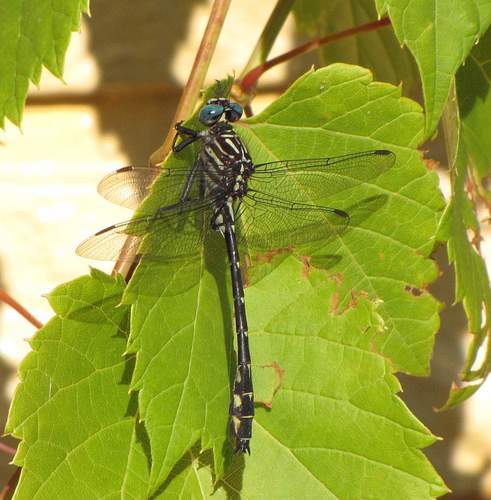


Elusive Clubtail
stylurus notatus
The Elusive Clubtail (Stylurus notatus) is a fascinating species of dragonfly, aptly named for its tendency to remain hidden along the banks of clean, flowing rivers and streams. This clubtail is a testament to the health of its aquatic environment, as its presence often indicates good water quality. It belongs to the family Gomphidae, known for their robust bodies and distinctive 'club' at the end of the male's abdomen. Observing an Elusive Clubtail in the wild is a rewarding experience for nature enthusiasts, requiring patience and a keen eye due to its camouflaged appearance and preference for less disturbed habitats.
Hábitat: Found in clean, moderately flowing rivers and large streams with sandy or silty bottoms, often near stretches with emergent vegetation.
Adult Elusive Clubtails are medium-sized dragonflies, typically ranging from 5 to 6.5 cm in length, with a wingspan of about 6 to 8 cm. Their bodies are predominantly black with striking yellow markings. The thorax displays bold yellow stripes, while the abdomen features yellow spots or streaks along the top. Males possess a distinctive, flattened and expanded 'club' at the end of their abdomen (segments 7-9), which is primarily black. The eyes are widely separated and typically green or yellowish-green. Their wings are clear, with dark veins and a dark pterostigma.
Categoría
InsectosRareza
Common
Peligro
1/5 · Muy bajo
Snaps
¡Sé la primera persona en hacer un snap!
Elusive Clubtails are known for their strong, direct flight and their habit of perching horizontally on flat surfaces close to the ground or water.
Like all dragonflies, the Elusive Clubtail spends the majority of its life (2-4 years) as an aquatic nymph before emerging as a flying adult for only a few weeks.
The 'club' on the male's abdomen is a distinguishing feature of the Gomphidae family, though not all species have such a prominent one.
The scientific name 'Stylurus' comes from Greek, meaning 'pillar tail,' referring to the distinctive shape of their abdomens.
The larvae of the Elusive Clubtail are adapted to burrow into the sandy or silty substrate of riverbeds, using their flattened bodies and cryptic coloration to hide from predators and ambush prey.
Adult clubtails are agile flyers that often perch on vegetation or rocks along the water's edge. From these vantage points, they launch quick, darting attacks to capture flying insect prey in mid-air.
The presence of Stylurus notatus larvae and adults is often an indicator of good to excellent water quality, as they are sensitive to pollution and require clean, well-oxygenated aquatic environments.
Both larval and adult Elusive Clubtails are predatory insectivores. Larvae feed underwater on aquatic invertebrates, while adults hunt flying insects in the air.
Diferencias por edad: Larvae feed on aquatic invertebrates in the water column and benthic zones. Adults feed exclusively on flying insects captured in the air.
Culex pipiens
Adult Elusive Clubtails hunt and consume various small flying insects.
Micropterus dolomieu
Elusive Clubtail larvae are prey for various fish species within their aquatic habitat.
Tyrannus tyrannus
Adult Elusive Clubtails can fall prey to larger insectivorous birds.
Elodea canadensis
Aquatic vegetation provides shelter and hunting grounds for larval clubtails.
Aún no hay insignias de rasgos asignadas a este objeto.
Todavía no hay alias listados.
Las colecciones para este objeto aparecerán aquí a medida que se añadan más temas.
Peligro
1/5 · Muy bajo
Todavía no hay notas especiales de seguridad.
La forma más fácil de identificar a Elusive Clubtail es usar la aplicación de identificación de naturaleza Snappit.
5-6 cm
6-8 cm
0.0005-0.001 kg
2-4 años
45 km/h
Both larval and adult Elusive Clubtails are predatory insectivores. Larvae feed underwater on aquatic invertebrates, while adults hunt flying insects in the air.
Found in clean, moderately flowing rivers and large streams with sandy or silty bottoms, often near stretches with emergent vegetation.
Acércate para separar los grupos y explorar dónde se ha fotografiado este objeto.
Los snaps recientes aparecerán aquí a medida que se añadan nuevas observaciones.




%2C_Fort_du_Loc%27h%2C_Guidel%2C_Brittany%2C_France_(19900725286)_(cropped).jpg&width=800)














