




Emaravirus
emaravirus
Los emaravirus son un género único y fascinante de virus ARN que infectan plantas, pertenecientes a la familia Fimoviridae. Estos patógenos microscópicos se distinguen por sus genomas multipartitos, lo que significa que su plan genético se divide en varios segmentos separados de ARN monocatenario. A diferencia de muchos otros virus vegetales, los emaravirus no pueden propagarse fácilmente por sí solos o por contacto mecánico. En cambio, dependen de una relación altamente especializada con ácaros eriófidos microscópicos, que actúan como vectores específicos para transportarlos de un huésped a otro. Los emaravirus son responsables de causar varias enfermedades vegetales agrícolas y ecológicas notables a nivel mundial.
Hábitat: Típicamente se encuentra dentro del tejido vascular y las células de las plantas hospedadoras, así como dentro de los cuerpos de sus vectores especializados, los ácaros eriófidos.
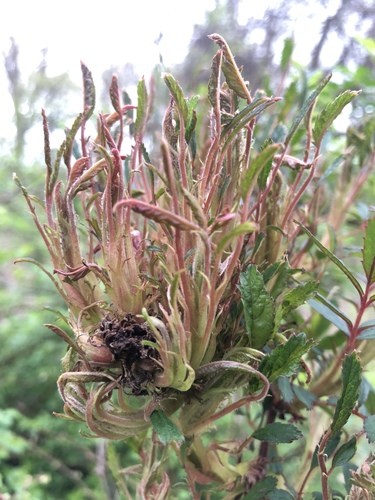
Dado que los emaravirus son viriones microscópicos que miden solo de 80 a 100 nanómetros de diámetro, no pueden verse directamente a simple vista. Los observadores pueden identificar su presencia por los síntomas distintivos que producen en las plantas hospedadoras infectadas. Estos síntomas incluyen llamativas manchas anulares amarillas, patrones de mosaico en las hojas, distorsión de las hojas y 'escoba de bruja', una aglomeración anormal y densa de ramitas y ramas que se asemeja a una escoba. En las rosas, una infección a menudo causa una decoloración roja brillante de las hojas y tallos y una proliferación de espinas inusualmente suaves y gruesas.
Categoría
AnimalRareza
Común
Peligro
1/5 · Muy bajo
Snaps
¡Sé la primera persona en hacer un snap!
Los ácaros eriófidos pueden portar el virus en su intestino y glándulas salivales, transmitiéndolo a nuevas hojas mientras se alimentan.
El nombre del género 'Emaravirus' es un acrónimo derivado de la primera especie identificada: European mountain ash ringspot-associated virus (EMARAV).
A diferencia de muchos virus con hebras genéticas simples, los emaravirus tienen un genoma altamente complejo y fragmentado dividido en hasta ocho envolturas separadas.
Explota ácaros eriófidos microscópicos de cuatro patas para lograr un transporte y transmisión altamente específicos de planta a planta.
Utiliza una estructura de ARN multipartita de cuatro a ocho segmentos, lo que permite al virus adaptarse fácilmente y evolucionar rápidamente.
Secuestra con éxito la maquinaria de traducción de la planta huésped para producir proteínas virales, eludiendo las defensas inmunitarias de la planta.
Los emaravirus no consumen alimento físico; en cambio, se replican extrayendo recursos metabólicos y maquinaria celular directamente de las células vegetales infectadas.
Phyllocoptes fructiphilus
Utiliza este ácaro microscópico como un vector altamente específico para transmitir el virus del rosal de la roseta a los rosales hospedadores.
Sorbus aucuparia
Sirve como planta hospedadora principal para el Virus Asociado a Manchas Anulares del Serbal Europeo, lo que provoca clorosis foliar.

Rosa multiflora
Infecta esta especie invasora de rosa, causando una rápida elongación del tallo y distorsión de las hojas.
Los animales sociales viven en grupos organizados, cooperando para obtener beneficios de supervivencia como la búsqueda de alimento, la defensa y la cría de descendencia.
Colorido describe a organismos u objetos que exhiben una amplia variedad de colores brillantes y distintivos.
Este rasgo caracteriza a los organismos cuya dieta consiste total o principalmente en material vegetal.
Los animales diurnos están activos principalmente durante el día y suelen descansar o dormir por la noche.
Describe organismos que transfieren polen, permitiendo la fertilización y reproducción de las plantas.
Todavía no hay alias listados.
Las colecciones para este objeto aparecerán aquí a medida que se añadan más temas.
Peligro
1/5 · Muy bajo
Todavía no hay notas especiales de seguridad.
La forma más fácil de identificar a Emaravirus es usar la aplicación de identificación de naturaleza Snappit.
Los emaravirus no consumen alimento físico; en cambio, se replican extrayendo recursos metabólicos y maquinaria celular directamente de las células vegetales infectadas.
Típicamente se encuentra dentro del tejido vascular y las células de las plantas hospedadoras, así como dentro de los cuerpos de sus vectores especializados, los ácaros eriófidos.
Invasión Parasitaria De Células
Acércate para separar los grupos y explorar dónde se ha fotografiado este objeto.
Los snaps recientes aparecerán aquí a medida que se añadan nuevas observaciones.
Llévate el descubrimiento
Haz una foto con Snappit, identifica la especie y guarda el hallazgo en tu colección.