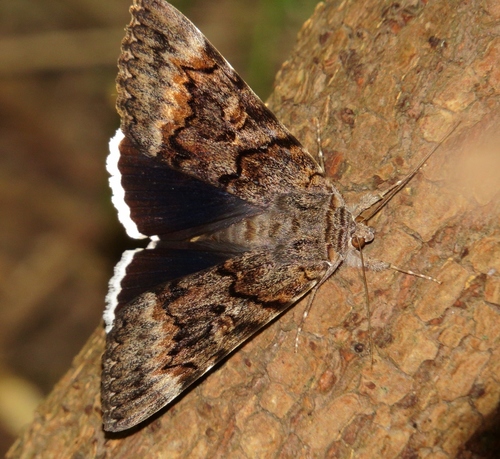


Epione Underwing
catocala epione
The Epione Underwing (Catocala epione) is a captivating member of the Erebidae family, renowned for its masterful dual-defense system. Like other underwing moths, it relies on a stark contrast between its drab, camouflaged forewings and its vividly colored hindwings to survive in eastern North American woodlands. During the day, it rests flat against tree trunks, perfectly blending in with the rough bark. If a predator approaches too closely, the moth suddenly reveals its bright hindwings in a flash of color, startling the attacker and allowing a quick escape. This species plays an important role in deciduous forest ecosystems, both as an herbivorous caterpillar feeding on canopy foliage and as a crucial food source for bats and insectivorous birds.
Hábitat: Typically found in temperate deciduous forests and mixed eastern woodlands with an abundance of hickory, pecan, or oak trees.
This moderately sized moth features a wingspan of roughly 5 to 7 centimeters. Its forewings are highly cryptic, displaying intricate mottled patterns of brown, gray, and black that expertly mimic the texture and coloring of tree bark. In striking contrast, the hidden hindwings possess bold, broad bands of black and dark yellow or orange, typically fringed with a lighter outer edge. When resting, the forewings are folded completely flat over the abdomen, entirely concealing the vibrant colors beneath. The body is robust and covered in fine hairs, characteristic of erebid moths, alongside slender, thread-like antennae.
Categoría
InsectosRareza
Common
Peligro
1/5 · Muy bajo
Snaps
¡Sé la primera persona en hacer un snap!
Instead of spinning a traditional silk cocoon on a branch, their caterpillars descend to pupate in the leaf litter on the forest floor, using debris for camouflage.
Like many underwings, they possess specialized 'ears' on their thorax that help them dive out of the way when they hear a bat approaching.
Many moth enthusiasts use 'sugaring'-painting a fermented mixture of rotting bananas, brown sugar, and beer onto trees-to attract these elusive moths at night.
The genus name Catocala translates to 'below beautiful' in Greek, perfectly describing the hidden beauty of their brightly colored hindwings.
Perfectly mimics the complex patterns of tree bark with its forewings to remain invisible to diurnal predators.
Flashes its brightly banded hindwings when disturbed to confuse or temporarily blind attackers, facilitating an escape.
Possesses specialized tympanal organs on its thorax capable of detecting the high-frequency echolocation calls of hunting bats.
Caterpillars feed extensively on the foliage of host trees, while adult moths use their proboscis to sip fermenting sap and rotting fruit juices.
Diferencias por edad: Larvae are entirely folivorous, consuming massive amounts of leaves, whereas adults only consume liquid nutrients like tree sap and nectar.
Carya ovata
Serves as the primary food source for the caterpillars.
Eptesicus fuscus
Hunts the adult moths at night using echolocation.
Cyanocitta cristata
Preys upon both caterpillars and resting adult moths during the day.
Aún no hay insignias de rasgos asignadas a este objeto.
Todavía no hay alias listados.
Las colecciones para este objeto aparecerán aquí a medida que se añadan más temas.
Peligro
1/5 · Muy bajo
Todavía no hay notas especiales de seguridad.
La forma más fácil de identificar a Epione Underwing es usar la aplicación de identificación de naturaleza Snappit.
3-4 cm
5-7 cm
0.001-0.003 kg
1 años
15 km/h
Caterpillars feed extensively on the foliage of host trees, while adult moths use their proboscis to sip fermenting sap and rotting fruit juices.
Typically found in temperate deciduous forests and mixed eastern woodlands with an abundance of hickory, pecan, or oak trees.
Acércate para separar los grupos y explorar dónde se ha fotografiado este objeto.
Los snaps recientes aparecerán aquí a medida que se añadan nuevas observaciones.


















