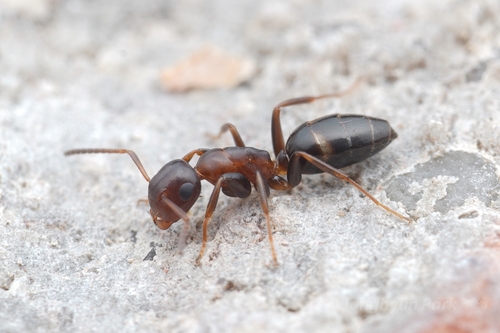


European Gate-Keeper Ant
colobopsis truncata
The European Gate-Keeper Ant, Colobopsis truncata, is a fascinating arboreal ant species known for its unique 'gate-keeper' defense mechanism. Unlike many ground-dwelling ants, this species builds its nests primarily within dead wood and tree hollows, often found in oak and fruit trees. Its most distinctive feature is the highly modified, disc-shaped head of its major workers, which they use to physically block nest entrances against intruders. This specialized adaptation, known as phragmosis, allows the colony to effectively 'lock' itself away from predators and competitors. These ants play a role in their ecosystem by foraging for small insects and collecting honeydew, making them an interesting subject for naturalists.
Hábitat: Found primarily in dead wood, such as stumps, fallen branches, and hollows within living or decaying trees, often in deciduous or mixed forests.
Workers of Colobopsis truncata are relatively small, typically ranging from 3 to 8 mm in length, with a glossy, dark brown to black coloration. Minor workers have a more typical ant head shape, while the major workers (soldiers) possess a strikingly flattened, truncated, and disc-like head that is roughly circular when viewed from the front. This unique head acts as a perfect plug for the circular nest entrances they excavate. Their bodies are slender, and they have the characteristic elbowed antennae of ants.
Categoría
InsectosRareza
Common
Peligro
1/5 · Muy bajo
Snaps
¡Sé la primera persona en hacer un snap!
Colobopsis truncata colonies are typically monogyne (having a single queen), and their nests often consist of multiple galleries and chambers within a single piece of wood.
The major workers' flattened heads are not just for defense; they also serve to plug and seal the nest entrances, making it difficult for other insects to enter.
These ants are largely arboreal, spending most of their lives in trees and rarely venturing to the ground unless relocating or foraging for specific resources.
They are part of a fascinating group of ants known for phragmosis, where different species have evolved similar 'door-head' adaptations independently.
Major workers have a disc-shaped head perfectly adapted to plug the entrance holes of their nests, creating an impenetrable barrier against intruders. This behavior is called phragmosis.
Unlike many ant species, Colobopsis truncata constructs its nests exclusively within dead wood, utilizing pre-existing tunnels or excavating its own intricate galleries, providing excellent protection.
The species exhibits distinct worker castes, including smaller minor workers and larger major workers, with the latter possessing the specialized 'gate-keeper' head for defense.
European Gate-Keeper Ants have a varied diet, primarily foraging for sweet secretions like honeydew produced by aphids, but also preying on small insects and other arthropods for protein.
Aphis spp.
Provides honeydew as a food source for ants
Cerambycidae spp.
Larvae can be prey for foraging ants, or they compete for dead wood resources
Araneus diadematus
Preys on adult ants and foraging workers
Dendrocopos major
May feed on ant colonies found within decaying wood
Aún no hay insignias de rasgos asignadas a este objeto.
Todavía no hay alias listados.
Las colecciones para este objeto aparecerán aquí a medida que se añadan más temas.
Peligro
1/5 · Muy bajo
Todavía no hay notas especiales de seguridad.
La forma más fácil de identificar a European Gate-Keeper Ant es usar la aplicación de identificación de naturaleza Snappit.
0 cm
0.000001-0.000005 kg
0-10 años
European Gate-Keeper Ants have a varied diet, primarily foraging for sweet secretions like honeydew produced by aphids, but also preying on small insects and other arthropods for protein.
Found primarily in dead wood, such as stumps, fallen branches, and hollows within living or decaying trees, often in deciduous or mixed forests.
Foraging
Acércate para separar los grupos y explorar dónde se ha fotografiado este objeto.
Los snaps recientes aparecerán aquí a medida que se añadan nuevas observaciones.

















