

Faint-Spotted Palthis Moth
palthis asopialis
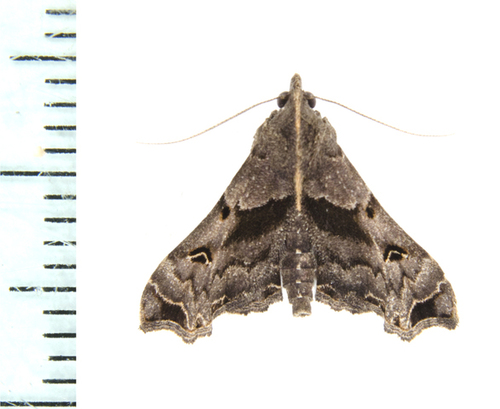
The Faint-Spotted Palthis Moth is a charming and inconspicuous member of the litter moth subfamily, Herminiinae. Widely distributed across eastern North America, this small insect plays a vital ecological role as a decomposer during its larval stage. What truly sets this moth apart is its remarkable facial anatomy, featuring elongated labial palps that project forward like a miniature beak, giving it a distinctive 'snouted' silhouette when resting on forest debris.
Hábitat: Found in deciduous forests, wooded parklands, and suburban gardens where leaf litter is abundant.
This moth has a wingspan of roughly 1.8 to 2.3 cm. Its forewings are typically light brown to grayish-tan, adorned with fine, wavy, darker brown lines and a faint, sometimes obscure dark spot near the center of each wing. A key identifier is the prominent, upward-curved labial palps on the head of males, which are densely tufted and resemble tiny horns, while females have slightly less exaggerated, straight palps.
Categoría
InsectosRareza
Common
Peligro
1/5 · Muy bajo
Snaps
¡Sé la primera persona en hacer un snap!
The species name asopialis refers to its historical taxonomic placement and appearance.
Their unusually long labial palps look like a miniature elephant trunk or a pair of extra legs extending from their head.
Unlike many other moths that rely strictly on green living plants, their caterpillars are crucial forest floor recyclers that eat dead leaves.
When resting on forest floors, it folds its wings and tucks its legs to perfectly mimic a tiny piece of dead, dried leaf.
Possesses highly modified, brush-like palps that are packed with sensory receptors, helping them navigate and detect pheromones.
The caterpillars have specialized gut enzymes that allow them to extract nutrients from tough, decaying leaf litter.
Larvae primarily feed on dead and decaying leaves on the forest floor, while adults sip nectar from various wild flowers.
Diferencias por edad: Larvae are detritivores feeding on leaf litter, whereas adults are herbivores feeding primarily on floral nectar.
Quercus alba
Caterpillars feed on the decaying leaves of this tree species.
Megascops asio
Adult moths are preyed upon by this common nocturnal hunter.
Phidippus audax
Spiders capture the adults in low-lying vegetation.
Aún no hay insignias de rasgos asignadas a este objeto.
Todavía no hay alias listados.
Las colecciones para este objeto aparecerán aquí a medida que se añadan más temas.
Peligro
1/5 · Muy bajo
Todavía no hay notas especiales de seguridad.
La forma más fácil de identificar a Faint-Spotted Palthis Moth es usar la aplicación de identificación de naturaleza Snappit.
12+ cm
23+ cm
8 km/h
Larvae primarily feed on dead and decaying leaves on the forest floor, while adults sip nectar from various wild flowers.
Found in deciduous forests, wooded parklands, and suburban gardens where leaf litter is abundant.
Foraging
50150+
Acércate para separar los grupos y explorar dónde se ha fotografiado este objeto.
Los snaps recientes aparecerán aquí a medida que se añadan nuevas observaciones.