

Fendler'S Pennycress
noccaea fendleri
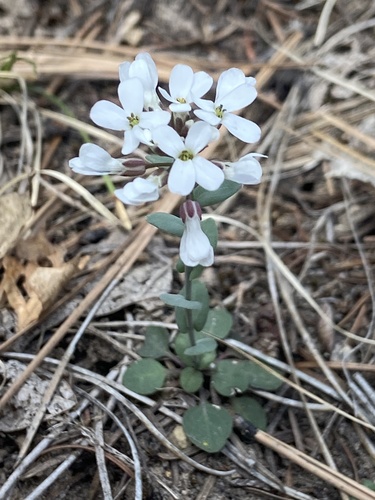
Fendler's Pennycress (Noccaea fendleri) is a hardy, delicate-looking perennial wildflower native to the mountainous regions of western North America. Thriving in alpine, subalpine, and montane environments, this resilient plant is often among the very first to bloom as winter snowpacks begin to recede. It is recognized by its dense clusters of small, white to soft lavender four-petaled flowers rising from a compact rosette of green leaves. Belonging to the mustard family, it plays a crucial role in early-season alpine ecosystems, offering a vital source of nectar to emerging pollinators. This species is particularly fascinating to ecologists and botanists due to its tolerance of harsh, rocky, and nutrient-poor soils.
Hábitat: Found in alpine meadows, subalpine forests, rocky slopes, and gravelly scree fields across western North American mountains.
Fendler's Pennycress grows between 5 and 35 centimeters tall, featuring a basal rosette of oval or spoon-shaped leaves that are sometimes slightly toothed. From this base rise one or more smooth, upright stems clad in smaller, heart-shaped leaves that clasp the stem directly without stalks. The top of each stem bears a dense, rounded cluster of small flowers, each possessing four white or pale-purple petals. As the flowers fade, they are replaced by highly characteristic flat, heart-shaped or reverse-triangular seed pods with a slight notch at the tip.
Categoría
PlantasRareza
Common
Peligro
1/5 · Muy bajo
Snaps
¡Sé la primera persona en hacer un snap!
Its unique seed pods resemble tiny shields or flattened purses, giving rise to its common name pennycress.
Like other members of the mustard family, the leaves of Fendler's Pennycress have a distinct, slightly peppery flavor.
Some species in its genus are utilized in phytoremediation, a process that uses plants to clean up contaminated soil.
Capable of growing in soils with elevated concentrations of heavy metals like zinc and cadmium without suffering physiological damage.
Adapted to emerge and bloom rapidly in early spring, often pushing through thin, melting alpine snowpacks.
Features sessile, stem-clasping leaves that help funnel dew and rainwater directly down the stem to the roots.
As a photoautotrophic plant, Fendler's Pennycress synthesizes its own sugars from sunlight, carbon dioxide, and water while absorbing essential minerals from the soil.
Pontia occidentalis
Serves as a host plant for the caterpillars of the Western White butterfly.
Bombus bifarius
Provides early spring nectar and pollen to emerging bumblebees.
Marmota flaviventris
Eaten by alpine herbivores grazing in subalpine meadows.
Aún no hay insignias de rasgos asignadas a este objeto.
Todavía no hay alias listados.
Las colecciones para este objeto aparecerán aquí a medida que se añadan más temas.
Peligro
1/5 · Muy bajo
Todavía no hay notas especiales de seguridad.
La forma más fácil de identificar a Fendler'S Pennycress es usar la aplicación de identificación de naturaleza Snappit.
5+ cm
0.005+ kg
3+ años
As a photoautotrophic plant, Fendler's Pennycress synthesizes its own sugars from sunlight, carbon dioxide, and water while absorbing essential minerals from the soil.
Found in alpine meadows, subalpine forests, rocky slopes, and gravelly scree fields across western North American mountains.
14+ días
Acércate para separar los grupos y explorar dónde se ha fotografiado este objeto.
Los snaps recientes aparecerán aquí a medida que se añadan nuevas observaciones.












