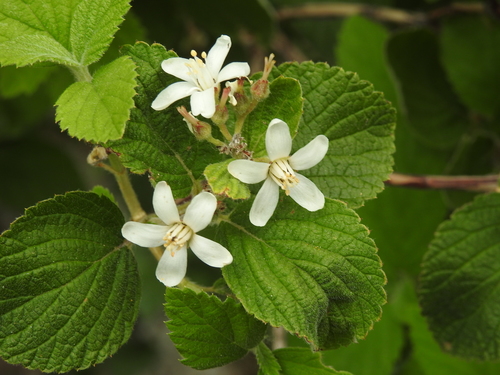


Fivepetal Cliffbush
jamesia americana
The Fivepetal Cliffbush (Jamesia americana) is an elegant, deciduous shrub native to the rocky, montane landscapes of the western United States. Clinging effortlessly to sheer canyon walls and steep talus slopes, this resilient woody plant is celebrated for its ability to thrive in harsh, nutrient-poor crevices where few other plants can take root. During late spring and early summer, it produces charming clusters of small, waxy white or pinkish-white flowers that contrast beautifully with its rugged surroundings. Historically, this species holds a special place in North American botany as it was discovered during the famous 1820 Long Expedition and named in honor of Edwin James, the expedition's botanist. In addition to its ecological role in securing loose soil and providing forage, it is highly valued by native plant enthusiasts for its stunning autumn display, when its leaves transform into deep shades of rose, orange, and copper.
Hábitat: Found on rocky cliffs, canyon walls, talus slopes, and subalpine rocky areas at elevations ranging from 1,600 to 3,000 meters.
This deciduous shrub typically grows to a height of 1 to 2 meters, forming a rounded, branching mound. Its most distinguishing feature is the shredded, peeling bark on older woody stems, which flakes away in thin, papery layers of gray and brown. The leaves are ovate, opposite, and heavily textured, featuring prominent veins and sharply serrated margins. The upper leaf surface is a dull green, while the underside is covered in dense, soft white hairs. In early summer, it bears small, terminal clusters of star-shaped, five-petaled flowers that are white to pale pink, each possessing a delicate, sweet fragrance.
Categoría
PlantasRareza
Common
Peligro
1/5 · Muy bajo
Snaps
¡Sé la primera persona en hacer un snap!
In the autumn, its leaves turn a deep, brilliant shade of rose-pink or coppery red, making it one of the most colorful native shrubs in the western canyons.
It belongs to the hydrangea family (Hydrangeaceae), which explains its delicate, clustered blooms and opposite leaf arrangement.
The genus name 'Jamesia' honors the American botanist Edwin James, who was the first European-American to summit Pikes Peak in 1820.
Possesses a highly specialized, opportunistic root system capable of penetrating deep into narrow rock fissures to anchor the shrub and seek out hidden pockets of moisture.
Sheds its outer bark in thin, papery layers, which helps prevent the accumulation of epiphytic mosses, lichens, and wood-boring pests.
The undersides of the leaves are covered in dense, fuzzy white hairs that trap a boundary layer of air, significantly reducing water loss from wind and intense solar radiation.
As a photosynthetic plant, the cliffbush manufactures its own food by converting sunlight, carbon dioxide, and water into sugars, supplemented by mineral nutrients drawn from mountain soils.
Ovis canadensis
Provides critical browse foliage and twigs during winter when other food sources are buried under deep snow.
Selasphorus platycercus
Visits the fragrant blooms in early summer to feed on nectar, acting as an effective pollinator.
Osmia lignaria
Collects pollen and nectar from the flowers, facilitating cross-pollination across isolated canyon walls.
Aún no hay insignias de rasgos asignadas a este objeto.
Todavía no hay alias listados.
Las colecciones para este objeto aparecerán aquí a medida que se añadan más temas.
Peligro
1/5 · Muy bajo
Todavía no hay notas especiales de seguridad.
La forma más fácil de identificar a Fivepetal Cliffbush es usar la aplicación de identificación de naturaleza Snappit.
50-200 cm
20-50 años
As a photosynthetic plant, the cliffbush manufactures its own food by converting sunlight, carbon dioxide, and water into sugars, supplemented by mineral nutrients drawn from mountain soils.
Found on rocky cliffs, canyon walls, talus slopes, and subalpine rocky areas at elevations ranging from 1,600 to 3,000 meters.
Acércate para separar los grupos y explorar dónde se ha fotografiado este objeto.
Los snaps recientes aparecerán aquí a medida que se añadan nuevas observaciones.




.jpg&width=800)