

Florida Bluehearts
buchnera floridana
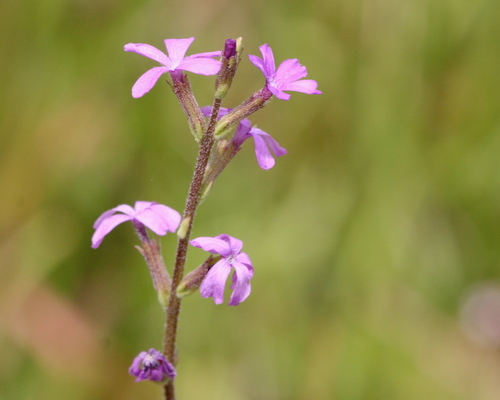
The Florida Bluehearts (Buchnera floridana) is an enchanting, slender wildflower native to the wetlands and pine flatwoods of the southeastern United States. While its delicate, pale-purple flowers lend a touch of serene beauty to grassy savannas, this plant harbors a fascinating secret beneath the soil. It is a hemiparasite, meaning that while it is fully capable of photosynthesis, it also actively steals water and essential nutrients from neighboring plants to supplement its growth. Historically cherished by wildflower enthusiasts, Florida Bluehearts plays a quiet but vital role in its ecosystem. It thrives in fire-adapted landscapes where frequent natural burns keep taller, shading shrubbery at bay. Spotting a cluster of these charming blue-violet blossoms swaying in a sunny bog is always a delightful reward for hikers exploring the wilder side of the southern flatwoods.
Hábitat: Typically found in wet pine flatwoods, savannas, pitcher plant bogs, and open, sandy wetlands.
This upright herbaceous wildflower typically grows between 30 and 80 centimeters tall, featuring a slender, rough-textured green stem that may branch near the top. Its leaves are small, lance-shaped, and arranged oppositely along the stem, with a noticeably sandpapery texture. The flowers are small, about 1 to 1.5 centimeters wide, consisting of five rounded, spreading lobes that form a slender tube at the base. They range in color from pale lavender and sky blue to deep violet-blue, clustered in a loose terminal spike that blooms from the bottom upward.
Categoría
PlantasRareza
Common
Peligro
1/5 · Muy bajo
Snaps
¡Sé la primera persona en hacer un snap!
They belong to the broomrape family, Orobanchaceae, making them close cousins to completely parasitic plants like beechdrops.
When dried as herbarium specimens or pressed in books, the vibrant blue flowers of the Florida Blueheart characteristically turn jet black.
While they steal nutrients from neighbors, they are not picky thieves; they can parasitize multiple species, including grasses, shrubs, and pine trees.
It utilizes specialized root structures called haustoria to pierce the roots of neighboring plants, extracting vital water and minerals.
This species thrives in fire-prone ecosystems, using the cleared understory and nutrient-rich ash left by wildfires to rapidly grow and bloom.
Its leaves and stems are covered in stiff, microscopic hairs that give the plant a sandpapery texture, deterring soft-bodied herbivores from feeding on it.
As a photosynthetic hemiparasite, it manufactures its own sugars using sunlight but relies on stealing water, nitrogen, and minerals from host plant roots.
Diferencias por edad: Seedlings rely strictly on their own photosynthetic capabilities and seed reserves until their roots successfully locate and attach to a host plant.
Aristida stricta
Florida Bluehearts parasitizes the root system of this dominant native grass.
Junonia coenia
Its nectar-rich flowers are pollinated by butterflies such as the Common Buckeye.
Pinus palustris
It also attaches parasitically to the roots of young pine seedlings to extract nutrients.
Aún no hay insignias de rasgos asignadas a este objeto.
Todavía no hay alias listados.
Las colecciones para este objeto aparecerán aquí a medida que se añadan más temas.
Peligro
1/5 · Muy bajo
Todavía no hay notas especiales de seguridad.
La forma más fácil de identificar a Florida Bluehearts es usar la aplicación de identificación de naturaleza Snappit.
30-80 cm
1-2 años
As a photosynthetic hemiparasite, it manufactures its own sugars using sunlight but relies on stealing water, nitrogen, and minerals from host plant roots.
Typically found in wet pine flatwoods, savannas, pitcher plant bogs, and open, sandy wetlands.
Parasitic Absorption
Acércate para separar los grupos y explorar dónde se ha fotografiado este objeto.
Los snaps recientes aparecerán aquí a medida que se añadan nuevas observaciones.