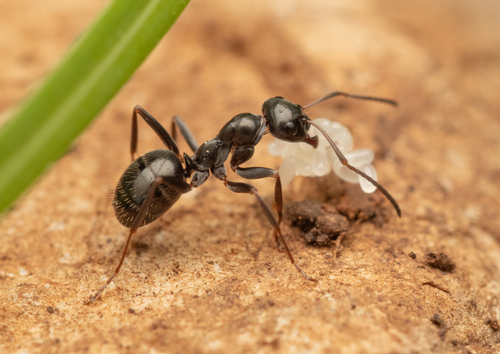


Formica Gagates
formica gagates
La Formica gagates, comúnmente conocida como Hormiga Brillante Negra, es una especie fascinante y extendida de hormiga de la madera que se encuentra en varias partes de Europa. Reconocida por su distintivo exoesqueleto negro brillante, esta hormiga desempeña un papel crucial en los ecosistemas forestales como depredadora y carroñera. Las colonias suelen establecerse dentro de madera muerta o debajo de piedras, donde mantienen complejas estructuras sociales. Son forrajeadoras diligentes, buscando constantemente recursos alimenticios y contribuyendo al proceso de descomposición. Sus interacciones con otras especies, particularmente su relación mutualista con los pulgones, destacan su importancia ecológica.
Hábitat: Formica gagates se encuentra típicamente en diversos entornos forestales, incluyendo bosques de coníferas y caducifolios, claros y bordes de bosques, a menudo anidando en madera en descomposición, tocones de árboles o bajo piedras y corteza.
Las obreras de Formica gagates se caracterizan por su coloración negra uniformemente brillante, lo que les confiere un aspecto elegante y pulido. Poseen un plan corporal de hormiga típico, segmentado en cabeza, tórax y abdomen, con seis patas delgadas. Las hormigas obreras son relativamente pequeñas, midiendo aproximadamente de 4 a 7 milímetros de longitud, lo que las hace fáciles de distinguir de especies de hormigas más grandes por su tamaño y brillo. Sus antenas son acodadas y prominentes.
Categoría
InsectosRareza
Común
Peligro
1/5 · Muy bajo
Snaps
¡Sé la primera persona en hacer un snap!
Las obreras de Formica gagates son conocidas por su apariencia negra increíblemente brillante, casi metálica, que les ayuda a absorber el calor cuando forrajean en áreas soleadas.
Como muchas especies de Formica, construyen intrincados nidos subterráneos o utilizan madera muerta existente, creando complejos sistemas de túneles que pueden albergar a miles de individuos.
La reina de una colonia de Formica gagates puede vivir más de una década, poniendo huevos continuamente para mantener la fuerza de trabajo de la colonia.
Su fuerte relación mutualista con los pulgones destaca un fascinante ejemplo de cooperación interespecífica, donde las hormigas 'cultivan' pulgones por sus dulces secreciones.
Cuando se sienten amenazadas, las obreras de Formica gagates pueden rociar un potente chorro de ácido fórmico desde sus abdómenes, actuando como un disuasivo químico contra depredadores y especies de hormigas rivales.
Estas hormigas establecen una relación mutualista con varias especies de pulgones, 'pastoreándolos' para que se alimenten de la savia de las plantas y luego consumiendo las secreciones azucaradas de melaza producidas por los pulgones.
Las Formica gagates son carroñeras muy eficaces, localizando y desmembrando rápidamente insectos muertos y otros detritos orgánicos para llevarlos de vuelta a su colonia, desempeñando un papel vital en el ciclo de nutrientes.
Formica gagates tiene una dieta variada, consumiendo principalmente insectos y otros artrópodos, tanto presas vivas como carroña. Complementan esta dieta rica en proteínas con sustancias azucaradas, destacando la melaza recolectada de los pulgones.

Acyrthosiphon pisum
Estas hormigas protegen a los pulgones de los depredadores a cambio de sus excreciones azucaradas.

Picus viridis
Las obreras de Formica gagates son depredadas por diversas aves insectívoras.
Lycosa tarantula
Las larvas y pupas de estas hormigas pueden ser consumidas por ciertas arañas depredadoras.
Formica rufa
Estas hormigas a menudo compiten con otras especies de hormigas por recursos alimenticios y sitios de anidación.
Aún no hay insignias de rasgos asignadas a este objeto.
Todavía no hay alias listados.
Las colecciones para este objeto aparecerán aquí a medida que se añadan más temas.
Peligro
1/5 · Muy bajo
Todavía no hay notas especiales de seguridad.
Compara las antenas, los segmentos de la cintura, las proporciones del cuerpo y el tamaño. Las obreras, las reinas y los machos de una misma especie pueden verse sorprendentemente distintos. Identificador de hormigas: sube una foto y compara los detalles visibles.
0 cm
0.000002-0.000005 kg
1-3 años
Formica gagates tiene una dieta variada, consumiendo principalmente insectos y otros artrópodos, tanto presas vivas como carroña. Complementan esta dieta rica en proteínas con sustancias azucaradas, destacando la melaza recolectada de los pulgones.
Formica gagates se encuentra típicamente en diversos entornos forestales, incluyendo bosques de coníferas y caducifolios, claros y bordes de bosques, a menudo anidando en madera en descomposición, tocones de árboles o bajo piedras y corteza.
Forrajeo
50-300
Acércate para separar los grupos y explorar dónde se ha fotografiado este objeto.
Los snaps recientes aparecerán aquí a medida que se añadan nuevas observaciones.
Llévate el descubrimiento
Haz una foto con Snappit, identifica la especie y guarda el hallazgo en tu colección.