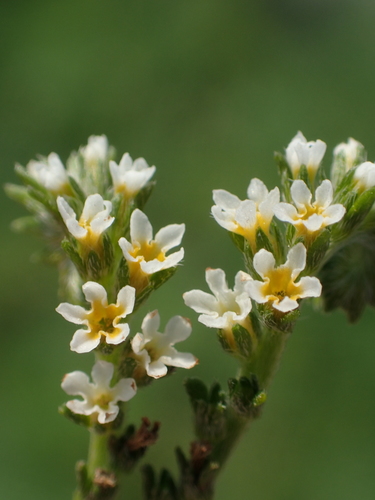


Fourspike Heliotrope
euploca procumbens
The Fourspike Heliotrope (Euploca procumbens) is a resilient, low-growing herb belonging to the borage family. Thriving in sandy, disturbed soils, riverbanks, and roadsides across the Americas, this species is well-adapted to harsh, sunny conditions. It is characterized by its prostrate growth form, sprawling across the ground to form dense, ground-hugging mats that help stabilize loose soil. What makes this plant particularly fascinating is its unique reproductive structure and chemical defenses. Its tiny white flowers are arranged in curled, one-sided spikes that slowly uncoil as the blossoms mature, while producing specialized alkaloids that deter generalist herbivores.
Hábitat: Found in open, disturbed habitats such as sandy riverbanks, roadsides, agricultural fields, and waste areas.
This plant is a prostrate or decumbent annual herb with branching stems extending 10 to 40 centimeters along the ground. The entire plant is covered in fine, appressed grayish hairs, giving the foliage a dusty-green or silvery appearance. Its leaves are small, lanceolate to elliptic, and arranged alternately. The most defining feature is the flowering spike, which typically splits into four branches of tightly coiled, scorpioid cymes bearing tiny, tubular white flowers with yellow throats, each measuring only 1 to 2 millimeters in diameter.
Categoría
PlantasRareza
Common
Peligro
1/5 · Muy bajo
Snaps
¡Sé la primera persona en hacer un snap!
It is a pioneer species, meaning it is one of the first plants to colonize barren, disturbed soils and help stabilize them.
The coiled shape of its flower head, which resembles a scorpion's tail, led ancient herbalists to believe the plant could cure scorpion stings.
The plant contains specialized alkaloids that are highly toxic to livestock but are eagerly sought after by certain moth species for defense.
Produces flowers on tightly coiled spikes that uncoil sequentially to maximize pollination success over time.
Synthesizes toxic pyrrolizidine alkaloids to deter mammalian and insect herbivores.
Features deep taproots and dense, hairy foliage that reduces water loss in arid, sandy environments.
As a photosynthetic plant, the Fourspike Heliotrope synthesizes its own food using sunlight, carbon dioxide, and water absorbed from the soil.
Apis mellifera
Visits the small white flowers to forage for nectar and pollen, aiding in pollination.
Utetheisa ornatrix
Caterpillars feed on the plant, sequestering pyrrolizidine alkaloids for their own chemical defense against predators.
Aún no hay insignias de rasgos asignadas a este objeto.
Todavía no hay alias listados.
Las colecciones para este objeto aparecerán aquí a medida que se añadan más temas.
Peligro
1/5 · Muy bajo
Todavía no hay notas especiales de seguridad.
La forma más fácil de identificar a Fourspike Heliotrope es usar la aplicación de identificación de naturaleza Snappit.
10-40 cm
0.01-0.1 kg
1-2 años
As a photosynthetic plant, the Fourspike Heliotrope synthesizes its own food using sunlight, carbon dioxide, and water absorbed from the soil.
Found in open, disturbed habitats such as sandy riverbanks, roadsides, agricultural fields, and waste areas.
Acércate para separar los grupos y explorar dónde se ha fotografiado este objeto.
Los snaps recientes aparecerán aquí a medida que se añadan nuevas observaciones.



















