






Fragile Forktail
Ischnura posita
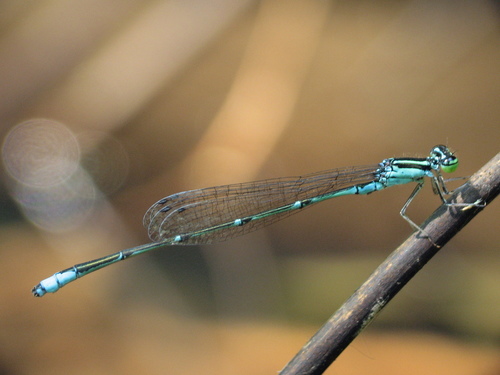
The Fragile Forktail is a tiny dragonfly that loves to flutter around ponds and streams. With its delicate wings and bright colors, it’s a beautiful sight to see as it dances in the air.
Hábitat: Wetlands
The Fragile Forktail is a tiny damselfly, usually sporting a slender black body with bright blue or green markings. It features a distinctive 'forked' tail-tip in males, which helps differentiate it from similar small damselflies.
Categoría
InsectosRareza
Common
Peligro
1/5 · Muy bajo
Snaps
¡Sé la primera persona en hacer un snap!
Male Fragile Forktails have a unique 'fork' or 'exclamation mark' shape on their tail!
Their babies, called nymphs, live entirely underwater and breathe with gills!
They often rest with their wings folded together over their back, unlike true dragonflies!
They spend most of their lives as nymphs, only flying as adults for a few short weeks!
Fragile Forktail has huge compound eyes that help them spot tiny flying prey from many directions at once.
Fragile Forktail can hover and dart quickly in mid-air because of its four independently moving wings, helping it catch fast-moving insects.
Fragile Forktail has a slender body and muted colors that help it blend into waterside plants, surprising unsuspecting prey.
Fragile Forktail larvae can breathe underwater using special gills, helping them hunt other small water creatures before becoming adults.
This tiny hunter loves to eat even tinier flying insects, keeping the air clear!
Diferencias por edad: Nymphs hunt aquatic insects, while adults catch flying bugs in the air.
Culex pipiens
Adults help control mosquito populations.
Rana catesbeiana
Adults and nymphs are a snack for frogs.
Anax junius
Larger dragonflies sometimes prey on them.
Typha latifolia
Nymphs hide among the roots and stems of aquatic plants.
Las criaturas aéreas pasan una parte importante de su vida en el aire, utilizando el vuelo para diversas actividades como la caza, la migración o la anidación.
Colorido describe a organismos u objetos que exhiben una amplia variedad de colores brillantes y distintivos.
Este rasgo identifica a los organismos cuya dieta consiste principalmente en insectos y otros pequeños invertebrados.
Este rasgo de hábitat identifica especies que se encuentran en humedales, que son áreas de tierra saturadas de agua, ya sea permanente o estacionalmente, e incluyen marismas, pantanos y ciénagas.

Los hábitats de agua dulce incluyen entornos acuáticos no salinos como ríos, lagos, estanques y humedales, vitales para numerosas especies.

Los animales diurnos están activos principalmente durante el día y suelen descansar o dormir por la noche.

Relativo a especies que son significativamente más pequeñas que lo típico o promedio de su tipo.

Este rasgo identifica a los organismos que exhiben una rapidez excepcional en sus movimientos para cazar, escapar o desplazarse.

Describe organismos que transfieren polen, permitiendo la fertilización y reproducción de las plantas.
Todavía no hay alias listados.
Peligro
1/5 · Muy bajo
Be gentle and quiet when watching dragonflies so you don't scare them away.
25-35 mm
18-28 mm
20-60 días
5-10 km/h
This tiny hunter loves to eat even tinier flying insects, keeping the air clear!
Wetlands
Pursuit
6
Acércate para separar los grupos y explorar dónde se ha fotografiado este objeto.
Los snaps recientes aparecerán aquí a medida que se añadan nuevas observaciones.
New York, US
Puedes ver Stream Bluet, Variable Dancer y Eastern Pondhawk.
Ver guía →
New Jersey, US
Puedes ver Libélula Azul, Eastern Pondhawk y Laughing Gull.
Ver guía →

District of Columbia, US
Puedes ver Libélula Azul, Fragile Forktail y Slaty Skimmer.
Ver guía →














