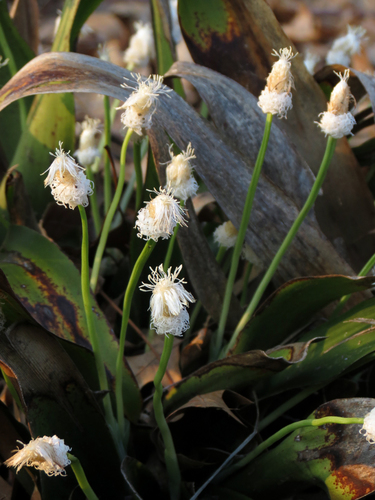


Fraser'S Sedge
carex fraseriana
Fraser's Sedge, Carex fraseriana, is a captivating perennial member of the sedge family, renowned for its striking white flower-like structures, which are actually modified bracts. Endemic to the Appalachian Mountains of eastern North America, this plant thrives in the cool, moist understory of rich deciduous forests. Its broad, pleated leaves are unusual for a sedge, giving it an ornamental appeal that sets it apart from its grass-like relatives. Often found in small colonies, Fraser's Sedge adds a touch of unique beauty to the forest floor, marking it as a distinctive and cherished native species.
Hábitat: Fraser's Sedge is typically found in the cool, moist understory of rich, mesic deciduous forests, often on slopes, along stream banks, or in rocky crevices with well-drained but consistently damp soil.
This sedge features broad, dark green leaves that are notably pleated, reminiscent of a fan, and grow in a basal rosette, typically reaching 20-40 cm in length. The most distinctive feature is its inflorescence, which appears in late spring. A short, upright stem emerges from the center of the rosette, bearing a dense, rounded cluster of inconspicuous flowers subtended by large, showy, pure white bracts that give the appearance of a single, prominent white flower, about 2-3 cm in diameter. The overall plant height, including the flower stalk, ranges from 15-30 cm.
Categoría
PlantasRareza
Common
Peligro
1/5 · Muy bajo
Snaps
¡Sé la primera persona en hacer un snap!
Despite being a sedge, which are typically wind-pollinated, the prominent white bracts may attract generalist insect visitors, though wind remains the primary method of pollen dispersal.
Fraser's Sedge is unique among Carex species for having broad, pleated leaves that resemble those of lilies or hostas, rather than the typical grass-like foliage of most sedges.
Its scientific name, Carex fraseriana, honors Scottish botanist John Fraser, who collected many plant specimens in the Appalachian region in the late 18th century.
The showy white "flower" of Fraser's Sedge is actually an involucre of modified leaf-like bracts surrounding a compact cluster of its tiny, inconspicuous male and female flowers, a rare trait for its genus.
Fraser's Sedge is highly adapted to low light conditions, thriving in the deep shade of mature deciduous forests where many other plants struggle to photosynthesize effectively. Its broad, pleated leaves maximize light capture in dim environments.
This plant reproduces and spreads primarily through underground rhizomes, allowing it to form localized colonies and persist in its preferred habitat, even in areas with limited seed dispersal or germination success.
While sedges are typically wind-pollinated and have inconspicuous flowers, Fraser's Sedge possesses prominent white bracts that encircle its small floral spikes. These large, petal-like structures may serve to attract pollinators, despite being predominantly wind-pollinated, or act as a visual beacon in the dark forest understory.
As a photosynthetic organism, Fraser's Sedge produces its own food by converting sunlight, carbon dioxide, and water into sugars through photosynthesis, supplemented by absorbing essential mineral nutrients from the soil.
Fagus grandifolia
Provides shade and competes for resources.
Odocoileus virginianus
Herbivore that may browse on the foliage.
Various fungal species
Forms symbiotic relationship to enhance nutrient uptake.
Various bacterial and fungal species
Decomposes plant matter, contributing to soil nutrients.
Aún no hay insignias de rasgos asignadas a este objeto.
Todavía no hay alias listados.
Las colecciones para este objeto aparecerán aquí a medida que se añadan más temas.
Peligro
1/5 · Muy bajo
Todavía no hay notas especiales de seguridad.
La forma más fácil de identificar a Fraser'S Sedge es usar la aplicación de identificación de naturaleza Snappit.
15-30 cm
5-15 años
As a photosynthetic organism, Fraser's Sedge produces its own food by converting sunlight, carbon dioxide, and water into sugars through photosynthesis, supplemented by absorbing essential mineral nutrients from the soil.
Fraser's Sedge is typically found in the cool, moist understory of rich, mesic deciduous forests, often on slopes, along stream banks, or in rocky crevices with well-drained but consistently damp soil.
Nutrient Uptake And Photosynthesis
Acércate para separar los grupos y explorar dónde se ha fotografiado este objeto.
Los snaps recientes aparecerán aquí a medida que se añadan nuevas observaciones.











