

Gassy Webcap
cortinarius traganus
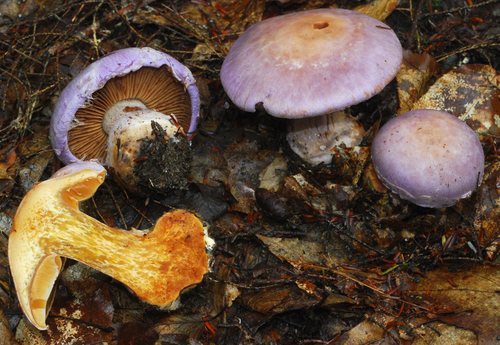
The Gassy Webcap (Cortinarius traganus) is a distinctive and intriguing mushroom species belonging to the large and diverse family Cortinariaceae. Known for its striking appearance and highly unusual scent, this fungus is a key player in coniferous forest ecosystems across the Northern Hemisphere. It is easily recognized by its initial pale lilac to silvery-violet color, which beautifully carpets forest floors, though it quickly shifts to a dull yellowish-brown as it matures. What truly sets this species apart, however, is its notorious odor. The mushroom emits a powerful, unpleasant chemical aroma often described as resembling acetylene gas, goat sweat, or rotting pears. This pungent scent acts as a natural deterrent against many woodland herbivores. Beneath its lilac skin, the inner flesh of the Gassy Webcap is a surprising saffron-yellow or rusty-orange, creating a vivid contrast for foragers who cut it open. While visually captivating, this mushroom is inedible and mildly toxic, causing gastrointestinal distress if consumed. It forms vital ectomycorrhizal partnerships with evergreen trees, assisting them in nutrient absorption.
Hábitat: Found in coniferous and mixed forests, particularly under spruce and pine trees, on acidic soils.
This mushroom features a convex cap measuring 4 to 12 cm in diameter, which gradually flattens and develops a yellowish-brown center while maintaining pale lilac-violet edges. When young, a pale violet, cobweb-like partial veil (the cortina) covers the gills, later leaving rusty-brown spore remnants on the thick, bulbous stem. The gills underneath start as a dirty saffron-yellow before turning dark rusty-brown as the spores mature. Its robust stipe is 5 to 10 cm tall, matching the cap's violet hue externally, but cutting it open reveals a dense, distinctly saffron-yellow to ochre-brown interior.
Categoría
HongosRareza
Common
Peligro
1/5 · Muy bajo
Snaps
¡Sé la primera persona en hacer un snap!
Despite its attractive lilac-purple exterior, its inner flesh is a shocking saffron-yellow or rusty-brown color.
It is considered mildly toxic or inedible, with a highly bitter taste that matches its offensive scent.
The Gassy Webcap gets its common name from its pungent, chemically sweet odor, which is often compared to coal gas, acetylene, or rotten pears.
Emits a powerful, disagreeable odor resembling acetylene gas, which deters many potential herbivores from consuming it.
Features a delicate, cobweb-like partial veil that protects the developing gills and immature spores from pests and drying out.
Establishes a highly efficient subterranean network with conifer roots, exchanging soil nutrients and water for tree-produced carbohydrates.
Absorbs carbohydrates and organic sugars directly from its symbiotic host trees in exchange for soil minerals and water.
Picea abies
Establishes a mutualistic ectomycorrhizal partnership, exchanging water and soil nutrients for tree sugars.
Pinus sylvestris
Serves as an alternative host tree for mycorrhizal associations in northern pine woodlands.
Mycetophila fungorum
The larvae of this insect burrow into and feed on the fungal flesh of the fruiting body.
Aún no hay insignias de rasgos asignadas a este objeto.
Todavía no hay alias listados.
Las colecciones para este objeto aparecerán aquí a medida que se añadan más temas.
Peligro
1/5 · Muy bajo
Todavía no hay notas especiales de seguridad.
La forma más fácil de identificar a Gassy Webcap es usar la aplicación de identificación de naturaleza Snappit.
5-12 cm
0.05-0.2 kg
Absorbs carbohydrates and organic sugars directly from its symbiotic host trees in exchange for soil minerals and water.
Found in coniferous and mixed forests, particularly under spruce and pine trees, on acidic soils.
Symbiosis
Acércate para separar los grupos y explorar dónde se ha fotografiado este objeto.
Los snaps recientes aparecerán aquí a medida que se añadan nuevas observaciones.