

Ghost Ant
tapinoma melanocephalum
The Ghost Ant, Tapinoma melanocephalum, is a tiny and widespread invasive ant species known for its elusive appearance and rapid colonization capabilities. Originating from tropical and subtropical regions, it has become a common household pest in many parts of the world, thriving in warm, humid environments. These ants are highly adaptable, forming large colonies with multiple queens and demonstrating impressive efficiency in foraging and nesting within the smallest crevices. Their presence often goes unnoticed until their numbers become significant, making them a persistent challenge in pest management. Despite their small stature, Ghost Ants play a notable role in both natural and urban ecosystems as scavengers and, in some cases, mutualists with sap-feeding insects.
Hábitat: Found in a wide range of habitats from tropical forests to urban structures, often nesting in small, concealed spaces such as wall voids, potted plants, under loose bark, or inside electronics.
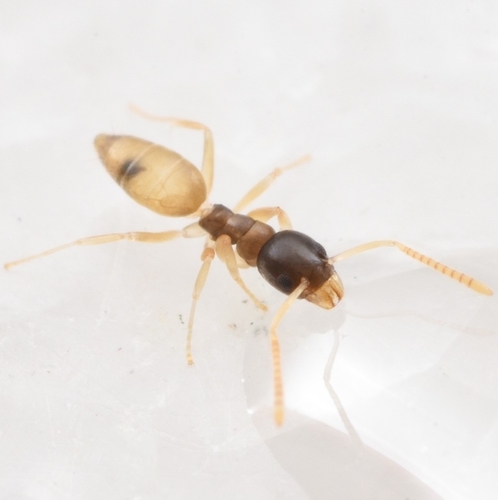
Ghost Ants are remarkably small, typically measuring between 1.3 to 2.0 millimeters in length. Their most distinctive visual feature is their bicolored appearance: the head and thorax are dark brown to black, while the legs, antennae, and abdomen are pale, translucent white or yellowish. This pale coloration, particularly of the abdomen, makes them difficult to see against light-colored surfaces, hence their common name. They possess 12-segmented antennae that lack a club, and their body is generally smooth and hairless.
Categoría
InsectosRareza
Common
Peligro
1/5 · Muy bajo
Snaps
¡Sé la primera persona en hacer un snap!
Ghost Ants are named for their pale, translucent legs and abdomen which make them extremely difficult to see, almost appearing to vanish and reappear.
Ghost ants often trail along electrical wires, baseboards, or under carpet edges, preferring warm, moist locations for nesting, which can sometimes lead to short circuits in electronics.
They are a 'tramp species', meaning they are easily transported across the globe through human commerce and goods, contributing to their widespread invasive success.
Unlike many ant species, Ghost Ant colonies can have multiple queens, a trait called polygyny, which allows them to grow rapidly and form new colonies by budding.
Ghost Ant colonies can have multiple queens and reproduce by 'budding,' where a subset of queens, workers, and brood detach from the main colony to establish new nests, allowing for rapid expansion and dispersal.
These ants are highly adaptable nesters, capable of establishing colonies in incredibly small and diverse locations, including wall voids, behind baseboards, under leaf litter, or in potted plants, making eradication challenging.
Individual Ghost Ants move in a fast, unpredictable, and erratic manner, making them harder to track and observe compared to many other ant species.
Ghost Ants primarily feed on sugary substances such as honeydew excreted by sap-feeding insects, nectar, and household sweets. They also scavenge on dead insects and other protein-rich food items.
Aphidoidea
Produce honeydew, a sugary secretion collected by ghost ants.
Salticidae
Predate on small ants, including ghost ants.
Linepithema humile
Compete with ghost ants for food resources and nesting sites.
Parulidae
Some bird species may consume ants as a small part of their diet.
Aún no hay insignias de rasgos asignadas a este objeto.
Todavía no hay alias listados.
Las colecciones para este objeto aparecerán aquí a medida que se añadan más temas.
Peligro
1/5 · Muy bajo
Todavía no hay notas especiales de seguridad.
La forma más fácil de identificar a Ghost Ant es usar la aplicación de identificación de naturaleza Snappit.
0 cm
0 cm
0.000001-0.000003 kg
1-2 años
Ghost Ants primarily feed on sugary substances such as honeydew excreted by sap-feeding insects, nectar, and household sweets. They also scavenge on dead insects and other protein-rich food items.
Found in a wide range of habitats from tropical forests to urban structures, often nesting in small, concealed spaces such as wall voids, potted plants, under loose bark, or inside electronics.
Foraging
Acércate para separar los grupos y explorar dónde se ha fotografiado este objeto.
Los snaps recientes aparecerán aquí a medida que se añadan nuevas observaciones.




_female_underside.jpg&width=800)









