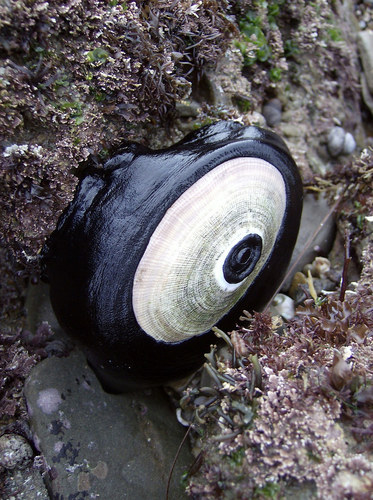


Giant Keyhole Limpet
megathura crenulata
The Giant Keyhole Limpet is a remarkably large marine mollusk native to the rocky shores of the Pacific coast of North America. Unlike typical limpets that rely heavily on a visible shell for protection, this unique gastropod is famous for its thick, velvety mantle that grows up and over its shell, leaving only a small, keyhole-like opening exposed at the top. This opening serves as an exit portal for water, waste, and reproductive cells. In scientific communities, this species is highly celebrated for its contribution to modern medicine. Its copper-based blood contains Keyhole Limpet Hemocyanin, a massive protein that stimulates the human immune system and is used globally in immunology research, diagnostic tests, and the development of cancer vaccines.
Hábitat: Found in rocky intertidal and shallow subtidal zones along Pacific coastlines, often clinging to reefs or hidden within dense kelp forests.
This massive limpet can reach up to 13 centimeters in length, featuring an oval shell with a distinct, keyhole-shaped opening near the center. However, the shell is usually completely covered by its thick, fleshy mantle, which varies in color from dark black and mottled grey to sandy tan. The underside reveals a broad, muscular foot used to grip rocky surfaces tightly.
Categoría
InvertebrateRareza
Common
Peligro
1/5 · Muy bajo
Snaps
¡Sé la primera persona en hacer un snap!
Its blue-colored blood contains a protein so complex that scientists have been unable to synthesize it in a laboratory, making wild or aquacultured limpets the only source.
The characteristic keyhole at the top of its shell acts like a chimney, allowing wastewater and reproductive materials to exit without getting trapped under the mantle.
Unlike most other limpets that have hard, exposed, cone-shaped shells, the Giant Keyhole Limpet looks and feels more like a large, velvety sea slug due to its expansive mantle.
Produces Keyhole Limpet Hemocyanin, a highly complex, oxygen-binding protein in its blood that serves as a powerful immunostimulant in human medicine.
Can expand its large mantle to cover and protect its entire shell from predators, preventing invasive organisms from settling on its hard surface.
Uses its wide, muscular foot to create a powerful suction seal on wave-swept rocks, preventing it from being washed away by strong Pacific swells.
It grazes slowly across rocky substrates, scraping up a variety of organic materials including algae, tunicates, bryozoans, and colonial sponges.
Pisaster ochraceus
Predator that preys on the limpet using its tube feet to pry it from rocks.
Tethya aurantia
The limpet grazes on this common tide pool sponge as part of its varied diet.
Octopus bimaculoides
A common cephalopod predator that hunts the limpet in subtidal zones.
Aún no hay insignias de rasgos asignadas a este objeto.
Todavía no hay alias listados.
Las colecciones para este objeto aparecerán aquí a medida que se añadan más temas.
Peligro
1/5 · Muy bajo
Todavía no hay notas especiales de seguridad.
La forma más fácil de identificar a Giant Keyhole Limpet es usar la aplicación de identificación de naturaleza Snappit.
6-13 cm
0.1-0.4 kg
5-15 años
It grazes slowly across rocky substrates, scraping up a variety of organic materials including algae, tunicates, bryozoans, and colonial sponges.
Found in rocky intertidal and shallow subtidal zones along Pacific coastlines, often clinging to reefs or hidden within dense kelp forests.
Grazing
10000-80000
Acércate para separar los grupos y explorar dónde se ha fotografiado este objeto.
Los snaps recientes aparecerán aquí a medida que se añadan nuevas observaciones.













