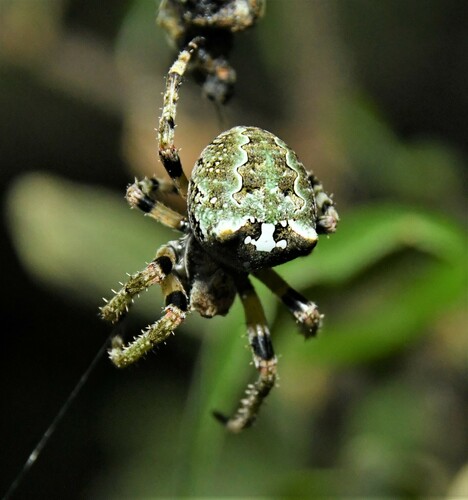


Giant Lichen Orbweaver
araneus bicentenarius
The Giant Lichen Orbweaver is one of the most spectacularly camouflaged spiders in North America. Named for its striking resemblance to tree-dwelling lichens, this impressive arachnid is a master of disguise, blending seamlessly into the bark of mature trees where it spins large, vertical, wheel-shaped webs. While its formidable size can be startling to encounter, this beneficial spider is harmless to humans and plays an essential role in forest ecosystems by keeping insect populations in check. Watching one sit motionless at the center of its web, looking exactly like a piece of moss-covered bark, is an incredible testament to natural selection. They are most commonly encountered during late summer and autumn when females reach their full, impressive size.
Hábitat: Typically found in mature deciduous and mixed forests, particularly on lichen-covered tree trunks, lichen-encrusted rock faces, and wooden structures.
This large spider features a highly textured, bulbous abdomen colored in shades of grayish-green, white, and black that mimic crustose lichen. Its legs are heavily banded with dark brown and light green rings, covered in small, stiff bristles. Females are significantly larger than males, reaching body lengths up to nearly 3 centimeters, excluding their legs, while males are much smaller and less conspicuous. A distinct pair of shoulder humps on the anterior portion of the abdomen is characteristic of this species, helping distinguish it from other orbweavers.
Categoría
InvertebrateRareza
Common
Peligro
1/5 · Muy bajo
Snaps
¡Sé la primera persona en hacer un snap!
Despite their intimidating size, these spiders are extremely docile and rarely bite humans, with their mild venom being harmless to people.
Like many orbweavers, the Giant Lichen Orbweaver often eats its own web at the end of the night to recycle the proteins used to make the silk.
The green coloration on their body is not caused by algae or lichen growing on them, but is entirely produced by their own natural pigments.
They spin their webs primarily at night and will hide in a nearby tree crevice during the day, holding a signal line connected to the web to feel for vibrations.
Its coloration and physical texture perfectly match the pale-green and grey lichens of its forest home, rendering it nearly invisible to both predators and prey when resting on tree bark.
It spins large, strong, vertical orb webs up to two feet in diameter to snare large flying insects, which it quickly rebuilds almost nightly.
Utilizing specialized slit sensilla on its legs, the spider can detect minute vibrations in the silk of its web to pinpoint the exact location and size of trapped prey.
Consumes a variety of flying insects caught in its sticky, vertical orb-webs, wrapping them in silk before feeding.
Diferencias por edad: Spiderlings feed on smaller insects like fruit flies and gnats, while mature adults target larger prey like cicadas and moths.
Actias luna
Prays upon large flying insects caught in its sticky orb web.
Cyanocitta cristata
Snatches spiders from their webs or bark retreats to feed to its young.
Chalybion californicum
Paralyzes orb-weaving spiders to provision its mud nests for its larvae.
Aún no hay insignias de rasgos asignadas a este objeto.
Todavía no hay alias listados.
Las colecciones para este objeto aparecerán aquí a medida que se añadan más temas.
Peligro
1/5 · Muy bajo
Todavía no hay notas especiales de seguridad.
La forma más fácil de identificar a Giant Lichen Orbweaver es usar la aplicación de identificación de naturaleza Snappit.
1-3 cm
0.0005-0.005 kg
1 años
Consumes a variety of flying insects caught in its sticky, vertical orb-webs, wrapping them in silk before feeding.
Typically found in mature deciduous and mixed forests, particularly on lichen-covered tree trunks, lichen-encrusted rock faces, and wooden structures.
Ambush
100-800
Acércate para separar los grupos y explorar dónde se ha fotografiado este objeto.
Los snaps recientes aparecerán aquí a medida que se añadan nuevas observaciones.













