

Gilbert'S Skink
plestiodon gilberti
Gilbert's Skink (Plestiodon gilberti) is a large, heavy-bodied lizard endemic to the far western United States, primarily California and surrounding regions. Renowned for its remarkable ontogenetic color transition, this species undergoes a striking metamorphosis from a vibrant, brightly striped juvenile to a stout, uniform-colored adult. As active daytime foragers, these skinks are crucial components of their ecosystems, serving as both effective predators of invertebrates and vital prey for larger carnivores. These lizards are adept at navigating subterranean spaces, frequently burrowing under loose soil, leaf litter, rocks, and logs. While they can be elusive and quick to retreat when disturbed, observing a Gilbert's Skink basking on a sunny rock or rustling through fallen leaves is a delightful reward for any patient nature enthusiast exploring the chaparral or oak woodlands.
Hábitat: Found in open woodlands, montane forests, chaparral, and riparian corridors, typically near rocky outcrops, loose soil, or fallen logs.
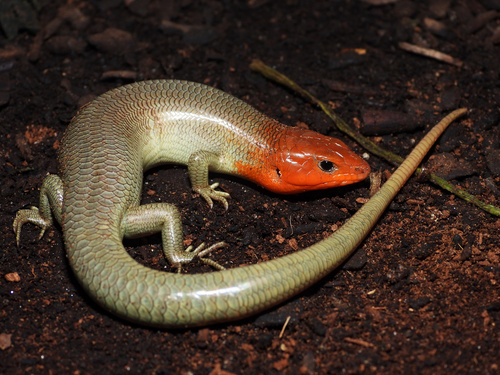
Adult Gilbert's Skinks are heavy-bodied lizards reaching lengths of 15 to 25 centimeters, featuring smooth, shiny cycloid scales that give them a polished appearance. They typically exhibit a uniform olive, brown, or greenish-tan coloration, occasionally developing a bright reddish or orange tint on their heads during the spring breeding season. In stark contrast, juveniles possess dark bodies with bright cream-colored longitudinal stripes and a stunning, brightly colored tail that ranges from bright pink to blue, which fades as they mature.
Categoría
ReptilesRareza
Common
Peligro
1/5 · Muy bajo
Snaps
¡Sé la primera persona en hacer un snap!
During the spring breeding season, adult males develop a bright reddish-orange coloration on their heads, signaling their fitness to potential mates.
Juvenile Gilbert's Skinks feature bright pink or blue tails, which are thought to draw predator attacks away from their vital organs to the detachable tail.
While most lizards bask in the direct open sun, Gilbert's Skinks often prefer 'cryptic basking' under warm rocks or wood to remain hidden from predators.
When threatened by a predator, this skink can self-amputate its tail, which continues to wiggle and distract the threat while the lizard escapes.
Using its streamlined head and strong limbs, the skink easily tunnels through loose soil, sand, and dense leaf litter to escape heat and predators.
It alters its coloration entirely from youth to adulthood, maximizing juvenile survival with a distracting bright tail and adult survival with cryptic background matching.
This skink is an active diurnal predator, foraging through leaf litter and soil for a wide variety of terrestrial invertebrates.
Diferencias por edad: Juveniles focus on smaller insects like ants and small spiders, while adults tackle larger prey including beetles, earthworms, and occasionally small lizards.
Gryllus integer
Preys on crickets during active daytime foraging sessions in chaparral leaf litter.
Masticophis lateralis
Frequently hunted by this agile snake, which actively pursues lizards through brush and rocky habitats.
Buteo jamaicensis
Preyed upon by birds of prey swooping down on basking skinks in open woodland clearings.
Aún no hay insignias de rasgos asignadas a este objeto.
Todavía no hay alias listados.
Las colecciones para este objeto aparecerán aquí a medida que se añadan más temas.
Peligro
1/5 · Muy bajo
Todavía no hay notas especiales de seguridad.
La forma más fácil de identificar a Gilbert'S Skink es usar la aplicación de identificación de naturaleza Snappit.
15-25 cm
0.01-0.04 kg
5-10 años
12 km/h
This skink is an active diurnal predator, foraging through leaf litter and soil for a wide variety of terrestrial invertebrates.
Found in open woodlands, montane forests, chaparral, and riparian corridors, typically near rocky outcrops, loose soil, or fallen logs.
Foraging
Acércate para separar los grupos y explorar dónde se ha fotografiado este objeto.
Los snaps recientes aparecerán aquí a medida que se añadan nuevas observaciones.













%2C_Abwehrhaltung.jpg&width=800)


