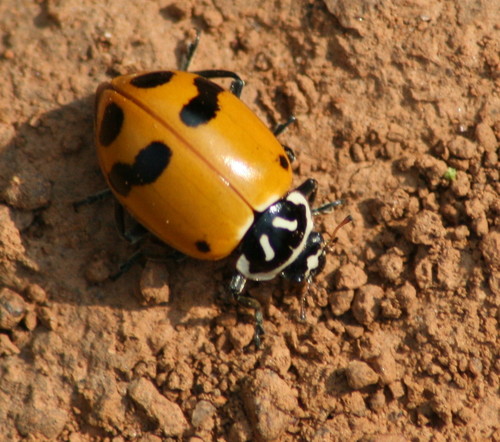


Glacial Lady Beetle
hippodamia glacialis
The Glacial Lady Beetle (Hippodamia glacialis) is a striking and beneficial member of the lady beetle family, native to North America. Often found in agricultural fields, meadows, and grasslands, this insect plays a crucial role in natural pest control. Unlike some of its more uniform relatives, the Glacial Lady Beetle is distinguished by its elongated oval body and unique, bold coloration, featuring a bright orange-to-red background marked with large, distinct black spots near the rear and a dark pronotum. Like other ladybugs, it is a voracious predator of soft-bodied agricultural pests, particularly aphids. Its presence is highly valued by gardeners and farmers alike, as it helps maintain ecological balance without the need for chemical pesticides. During the colder months, they aggregate in sheltered locations to overwinter, emerging in early spring to begin their active hunting cycle once again.
Hábitat: Typically found in open habitats such as agricultural fields, meadows, grasslands, and gardens, where host plants and aphid prey are abundant.
The Glacial Lady Beetle measures about 6 to 8 mm in length, possessing a moderately elongated, convex oval shape. Its elytra are typically a vibrant shade of orange to red-orange, with the anterior half mostly clear of markings except for a small black spot near the shoulder, while the posterior half features substantial, prominent black patches that often merge. The black pronotum is bordered with white or cream-colored markings, typically displaying two small convergent pale dashes in the center.
Categoría
InsectosRareza
Common
Peligro
1/5 · Muy bajo
Snaps
¡Sé la primera persona en hacer un snap!
A single beetle can consume more than 50 aphids a day, making them nature's miniature pest controllers.
Despite its name 'Glacial' Lady Beetle, it does not live on ice; the name honors its remarkable cold-hardiness and winter survival skills.
When they 'reflex bleed' as a defense mechanism, the bright yellow fluid they emit can permanently stain surfaces and carries a highly bitter taste to deter birds.
When threatened, it can exude a foul-smelling, bitter fluid containing toxic alkaloids from its leg joints to deter predators.
Uses specialized olfactory cues to locate dense colonies of aphids, allowing both adults and larvae to act as highly efficient predators.
Aggregates in large numbers under leaf litter, bark, or rocks to enter diapause and survive sub-zero winter temperatures.
A carnivorous insect that primarily preys on soft-bodied pests, particularly aphids, throughout its larval and adult life stages.
Diferencias por edad: Both larvae and adults are predatory, but adults will also feed on pollen and nectar when insect prey is scarce.
Aphis glycines
The Glacial Lady Beetle actively hunts and consumes these agricultural pests in large numbers.
Turdus migratorius
This bird species opportunistically preys on lady beetles when other insect prey is scarce.
Dinocampus coccinellae
A parasitic wasp that lays its eggs inside the adult lady beetle, eventually killing the host.
Aún no hay insignias de rasgos asignadas a este objeto.
Todavía no hay alias listados.
Las colecciones para este objeto aparecerán aquí a medida que se añadan más temas.
Peligro
1/5 · Muy bajo
Todavía no hay notas especiales de seguridad.
La forma más fácil de identificar a Glacial Lady Beetle es usar la aplicación de identificación de naturaleza Snappit.
A carnivorous insect that primarily preys on soft-bodied pests, particularly aphids, throughout its larval and adult life stages.
Typically found in open habitats such as agricultural fields, meadows, grasslands, and gardens, where host plants and aphid prey are abundant.
Foraging
Acércate para separar los grupos y explorar dónde se ha fotografiado este objeto.
Los snaps recientes aparecerán aquí a medida que se añadan nuevas observaciones.




.jpg&width=800)











