

Gold-Dust
aurinia saxatilis
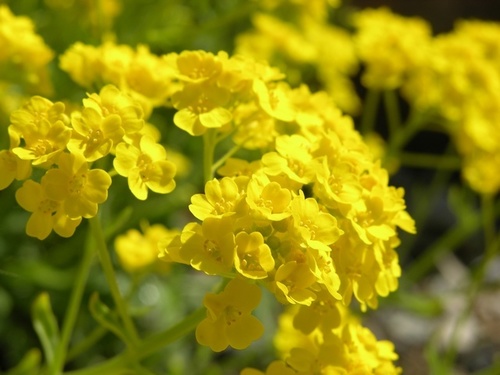
The Gold-Dust plant, scientifically known as Aurinia saxatilis, is a beloved evergreen perennial that belongs to the mustard family. Native to mountainous and rocky regions of Europe, this low-growing ground cover is famous for its dramatic explosion of bright, golden-yellow flowers in the spring, which resemble a blanket of gold dust scattered over the earth. It forms dense, low mats of foliage that cascade beautifully over rock walls, stony slopes, and garden borders. Highly resilient and adaptable, Gold-Dust thrives in sunny, dry environments where few other plants can survive. Its tough nature and outstanding ornamental value have made it a staple in rock gardens and xeriscaping worldwide, where it provides critical early-season nectar for various pollinating insects.
Hábitat: Typically found clinging to rocky cliffs, alpine crevices, limestone slopes, and dry stone walls in mountainous regions.
Gold-Dust forms mounded carpets of foliage reaching 15 to 30 cm in height. It features woody bases with oblong, lance-shaped, grey-green leaves that are covered in fine, felt-like hairs, giving them a soft, dusty texture. In mid-to-late spring, the plant is completely blanketed by terminal clusters of tiny, four-petaled, bright yellow flowers, each about 5 mm wide. These flowers are packed so densely in corymbs that they completely obscure the silver-grey foliage underneath, creating a brilliant, glowing golden effect.
Categoría
PlantasRareza
Common
Peligro
1/5 · Muy bajo
Snaps
¡Sé la primera persona en hacer un snap!
It was historically placed in the genus Alyssum and is still commonly referred to as Gold-dust Alyssum or Basket-of-Gold.
Its silver-grey hairy leaves act as natural sunscreen, reflecting intense solar radiation on exposed alpine mountainsides.
The species name saxatilis translates to growing among rocks, highlighting its extreme hardiness and preferred habitat.
Deep taproots and woody stems allow the plant to anchor securely in rocky fissures and access deep moisture.
Fine hairs on the grey-green leaves reduce water loss by trapping a boundary layer of humid air close to the leaf surface.
Synchronized mass flowering in early spring maximizes pollination opportunities from emerging insects.
As a photosynthetic plant, Gold-Dust generates its own energy from sunlight, carbon dioxide, and water while absorbing essential nutrients from the soil.
Apis mellifera
Forages on the nectar of the spring blooms, facilitating cross-pollination.
Pieris rapae
Foliage is occasionally consumed by caterpillars of Brassicaceae specialists.
Aún no hay insignias de rasgos asignadas a este objeto.
Todavía no hay alias listados.
Las colecciones para este objeto aparecerán aquí a medida que se añadan más temas.
Peligro
1/5 · Muy bajo
Todavía no hay notas especiales de seguridad.
La forma más fácil de identificar a Gold-Dust es usar la aplicación de identificación de naturaleza Snappit.
15-30 cm
0.1-0.4 kg
3-5 años
As a photosynthetic plant, Gold-Dust generates its own energy from sunlight, carbon dioxide, and water while absorbing essential nutrients from the soil.
Typically found clinging to rocky cliffs, alpine crevices, limestone slopes, and dry stone walls in mountainous regions.
14-21 días
Acércate para separar los grupos y explorar dónde se ha fotografiado este objeto.
Los snaps recientes aparecerán aquí a medida que se añadan nuevas observaciones.



.jpg)