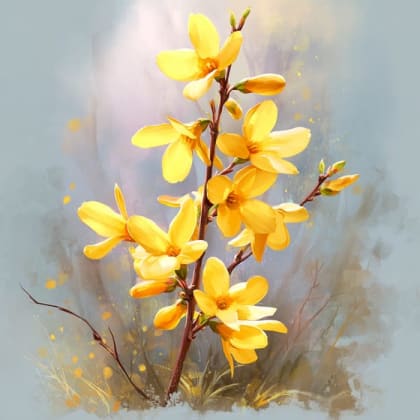
Golden Beeplant
cleomella platycarpa
The Golden Beeplant, scientifically known as Cleomella platycarpa, is an eye-catching annual wildflower native to the arid and semi-arid regions of the western United States. Gracing volcanic soils, clay slopes, and alkaline flats, this hardy member of the Cleomaceae family lights up dry landscapes with its brilliant clusters of golden-yellow flowers. The plant's common name reflects its irresistible appeal to native bees, butterflies, and other pollinators, who flock to its nectar-rich blossoms during the warm late spring and summer months. Historically overlooked as a simple desert weed, the Golden Beeplant plays a vital role in its local ecosystems by stabilizing disturbed soils and providing an essential food source for native insects in areas where water is scarce.
Hábitat: Found in open, arid environments, typically growing in alkaline flats, clay-rich hillsides, volcanic soils, and sagebrush scrublands.
The Golden Beeplant typically grows between 10 to 50 centimeters in height, featuring upright, branching stems that are smooth and light green. Its leaves are divided into three small, oval-shaped leaflets, while its most striking feature is the dense, rounded clusters of bright yellow flowers with exceptionally long, thread-like stamens that protrude far beyond the petals. Following pollination, it develops distinctively flattened, double-lobed, rhombic seed pods that dangle from slender stalks and turn a dry tan color as they mature.
Categoría
PlantasRareza
Common
Peligro
1/5 · Muy bajo
Snaps
¡Sé la primera persona en hacer un snap!
Its seed pods are shaped like tiny, flattened fans or diamonds, which distinguishes it from related plants in the mustard family that have elongated pods.
Like other members of the Brassicales order, it contains mustard oils (glucosinolates) which give the leaves a pungent taste to deter most mammalian herbivores.
The common name 'Beeplant' is highly literal; the flowers emit a sweet scent that attracts massive quantities of native bees.
Can thrive in heavy, highly alkaline clay and volcanic soils that are toxic or inhospitable to most other plant species.
Possesses exceptionally long stamens that efficiently brush pollen onto visiting bees and butterflies, ensuring successful cross-pollination.
Utilizes a rapid annual life cycle, germinating quickly after spring rains to bloom and set seeds before the extreme heat of the summer dehydrates the soil.
As a photosynthetic autotroph, the Golden Beeplant produces its own food using sunlight, water, carbon dioxide, and soil nutrients.
Apis mellifera
Bees pollinate the flowers while harvesting nectar and pollen.
Pieris rapae
Caterpillars feed on the leaves and seed pods, utilizing the plant's mustard oils for chemical defense.
Sylvilagus audubonii
Rabbits may graze on the young foliage during early spring when other greenery is scarce.
Aún no hay insignias de rasgos asignadas a este objeto.
Todavía no hay alias listados.
Las colecciones para este objeto aparecerán aquí a medida que se añadan más temas.
Peligro
1/5 · Muy bajo
Todavía no hay notas especiales de seguridad.
La forma más fácil de identificar a Golden Beeplant es usar la aplicación de identificación de naturaleza Snappit.
10-50 cm
0.01-0.15 kg
1 años
As a photosynthetic autotroph, the Golden Beeplant produces its own food using sunlight, water, carbon dioxide, and soil nutrients.
Found in open, arid environments, typically growing in alkaline flats, clay-rich hillsides, volcanic soils, and sagebrush scrublands.
Acércate para separar los grupos y explorar dónde se ha fotografiado este objeto.
Los snaps recientes aparecerán aquí a medida que se añadan nuevas observaciones.