

Golden Gilmania
gilmania luteola
The Golden Gilmania (Gilmania luteola) is an incredibly rare, delicate annual herb endemic to the hyper-arid environment of Death Valley, California. Belonging to the buckwheat family, this tiny botanical marvel has adapted to survive in some of the most inhospitable conditions on Earth, specifically thriving on highly alkaline and saline clay hills. Rather than growing tall, it forms low, sprawling mats that hug the barren ground, bursting into vibrant displays when rare desert rains provide enough moisture. What makes this plant particularly fascinating is its extreme specialization and boom-and-bust lifecycle. For years, its seeds lie completely dormant in the sun-baked soil, completely invisible to visitors. Following a wet winter, these seeds germinate rapidly to paint the pale desert badlands with spectacular, bright yellow carpets, creating a fleeting but unforgettable ecological event.
Hábitat: Found exclusively on the highly alkaline and saline clay badlands of the Furnace Creek formation in Death Valley National Park.
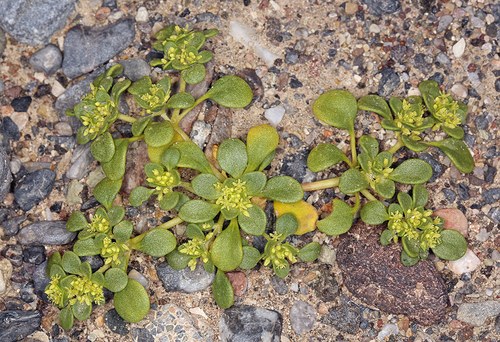
Golden Gilmania is a low-growing, prostrate annual plant that typically reaches only 2 to 10 centimeters in height, spreading outward to form cushion-like mats. Its small, fleshy leaves are rounded or spatula-shaped, covered in a dense layer of fine, white, woolly hairs that give them a silvery-green or greyish appearance. The flowers are tiny, bell-shaped, and a brilliant golden-yellow color, clustered densely in the leaf axils. The contrast between the bright yellow blooms, silver foliage, and the pale, chalky clay soils they grow on is their primary visual identifier.
Categoría
PlantasRareza
Common
Peligro
1/5 · Muy bajo
Snaps
¡Sé la primera persona en hacer un snap!
During dry years, not a single living specimen of Golden Gilmania may be visible above ground, existing solely as buried, resilient seeds.
It is named after M. French Gilman, a pioneer botanist of Death Valley who documented many of the region's rare endemic plants.
The Golden Gilmania belongs to a monotypic genus, meaning Gilmania luteola is the only species within its entire genus.
It can thrive in highly saline and alkaline clay soils that would dry out or poison almost any other plant species.
Its seeds possess an extraordinary ability to remain viable in scorching, dry soil for several years until optimal rainfall triggers germination.
The dense layer of white, woolly hairs on its leaves reflects intense desert sunlight, reducing moisture loss and preventing heat damage.
As a photosynthetic plant, the Golden Gilmania produces its own energy using sunlight, water, carbon dioxide, and minerals absorbed from the desert soil.
Andrena species
Provides nectar and pollen to specialized desert bees during its brief spring blooming period.
Gopherus agassizii
Occasionally grazed upon by desert herbivores seeking moisture in an otherwise barren landscape.
Aún no hay insignias de rasgos asignadas a este objeto.
Todavía no hay alias listados.
Las colecciones para este objeto aparecerán aquí a medida que se añadan más temas.
Peligro
1/5 · Muy bajo
Todavía no hay notas especiales de seguridad.
La forma más fácil de identificar a Golden Gilmania es usar la aplicación de identificación de naturaleza Snappit.
2-10 cm
0.01-0.05 kg
1 años
As a photosynthetic plant, the Golden Gilmania produces its own energy using sunlight, water, carbon dioxide, and minerals absorbed from the desert soil.
Found exclusively on the highly alkaline and saline clay badlands of the Furnace Creek formation in Death Valley National Park.
Photosynthesis
Acércate para separar los grupos y explorar dónde se ha fotografiado este objeto.
Los snaps recientes aparecerán aquí a medida que se añadan nuevas observaciones.