

Golden Pricklypear
opuntia aurea
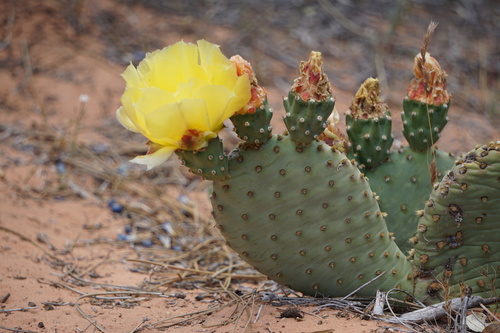
The Golden Pricklypear is a charming, low-growing cactus endemic to the rocky, arid landscapes of southern Utah and northern Arizona. Lacking the long, menacing spines typical of many other cacti in its genus, this plant spreads in low, sprawling mats of fleshy, pale-green pads. During late spring, it undergoes a spectacular transformation, blanketing itself in bright, golden-yellow flowers that serve as a crucial resource for native desert pollinators. While it may appear friendly and touchable due to its spineless nature, caution is advised. The plant is heavily armed with cushions of glochids—nearly invisible, barbed bristles that easily dislodge and irritate the skin. This hardy succulent is beautifully adapted to survive in harsh, drought-prone environments, making it a rugged survivor of the American Southwest.
Hábitat: Found in desert scrublands, pinyon-juniper woodlands, and sandy or gravelly slopes of the southwestern United States.
This low-growing succulent forms sprawling mats up to 40 cm tall and over 1 meter wide. The pads are obovate to round, grayish-green to pale-green, and notably lack long, rigid spines, instead featuring prominent circular areoles filled with dense, yellow-to-brown, hair-like glochids. In late spring, large, cup-shaped flowers about 5 to 7 cm wide bloom in shades of vibrant golden-yellow, which mature into spineless, dry, green-to-tan seed pods.
Categoría
PlantasRareza
Common
Peligro
1/5 · Muy bajo
Snaps
¡Sé la primera persona en hacer un snap!
Despite being commonly called 'spineless', it is actually covered in glochids—infinitesimally small, barbed hairs that are much harder to extract from skin than normal spines.
It can survive sub-zero winter temperatures in its high-desert habitat by partially dehydrating its pads to prevent ice crystals from rupturing its cells.
The species name 'aurea' is Latin for golden, referencing its bright yellow blossoms which lack the red centers found in many other pricklypear species.
Utilizes CAM photosynthesis, opening stomata at night to capture carbon dioxide, which drastically reduces water loss during scorching desert days.
Employs thousands of microscopic, barbed glochids that easily detach upon contact, causing persistent skin irritation to deter large herbivores.
Possesses pads that readily root upon touching moist soil, allowing the plant to clone itself and spread into dense colonies.
As a photoautotroph, it synthesizes its own food using sunlight, carbon dioxide, and water through photosynthesis, supplemented by soil minerals.
Diadasia opuntiae
Provides pollen and nectar to the cactus bee, which in turn acts as its primary pollinator.
Sylvilagus audubonii
Feeds on the moisture-rich pads and succulent fruits despite the presence of irritating glochids.
Chelinidea vittiger
Sucks sap from the green pads, occasionally leaving yellow feeding scars on the plant.
Aún no hay insignias de rasgos asignadas a este objeto.
Todavía no hay alias listados.
Las colecciones para este objeto aparecerán aquí a medida que se añadan más temas.
Peligro
1/5 · Muy bajo
Todavía no hay notas especiales de seguridad.
La forma más fácil de identificar a Golden Pricklypear es usar la aplicación de identificación de naturaleza Snappit.
10+ cm
1+ kg
20+ años
As a photoautotroph, it synthesizes its own food using sunlight, carbon dioxide, and water through photosynthesis, supplemented by soil minerals.
Found in desert scrublands, pinyon-juniper woodlands, and sandy or gravelly slopes of the southwestern United States.
Acércate para separar los grupos y explorar dónde se ha fotografiado este objeto.
Los snaps recientes aparecerán aquí a medida que se añadan nuevas observaciones.