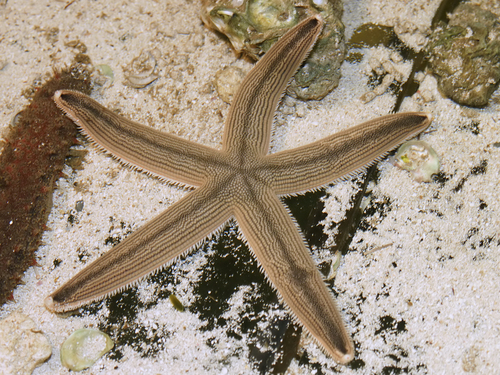


Gray Sea Star
luidia clathrata
The Gray Sea Star (Luidia clathrata) is an active and fascinating marine echinoderm native to the warm coastal waters of the western Atlantic. Unlike many of its slow-moving, rock-climbing relatives, this species is highly adapted for a dynamic life on soft, shifting sediments. Lacking the typical suction-cupped tube feet, it features pointed, agile tube feet that allow it to glide smoothly and rapidly across sandy and muddy sea floors, or quickly burrow beneath the surface to hide from predators or ambush prey.
Hábitat: Found in shallow coastal waters, typically on soft sandy or muddy sea floors where it can easily burrow.
This sea star typically features five long, flattened, tapering arms radiating from a relatively small central disc, reaching an overall diameter of 15 to 30 centimeters. Its coloration ranges from light bluish-gray to creamy gray or light brown, and it is easily recognized by a distinct, dark gray or blackish stripe running down the midline of the upper surface of each arm. The upper body is covered with tiny, table-like structures called paxillae that give it a finely granulated texture, while its underside reveals pale, pointed tube feet.
Categoría
AnimalRareza
Common
Peligro
1/5 · Muy bajo
Snaps
¡Sé la primera persona en hacer un snap!
It has the impressive ability to swallow small prey items, such as clams, completely whole; it then digests the soft tissues internally and spits the empty, clean shells back out.
The distinct dark line down the middle of its arms is formed by a precise biological alignment of its paxillae—tiny, umbrella-shaped skeletal plates that keep sand off its sensitive skin.
Unlike most sea stars that rely on suction cups to scale hard vertical rocks, the Gray Sea Star features pointed, claw-like tube feet uniquely adapted for scurrying over and tunneling into sand.
Uses its specialized, pointed tube feet to quickly shovel sand aside, allowing it to sink beneath the sediment within seconds to avoid predators or search for food.
Can voluntarily shed an arm when threatened or seized by a predator, later regenerating a complete new arm over several months.
Moves surprisingly fast over soft substrates using coordinated, stilt-like walking motions of its pointed tube feet rather than suction-cup crawling.
Primarily feeds on small, burrowing invertebrates such as bivalves, gastropods, and small crustaceans, which it swallows whole or digests externally.
Diferencias por edad: Juveniles feed on organic detritus and microscopic organisms in the sediment, while larger adults target shelled mollusks and active crustaceans.
Donax variabilis
Preys heavily on this small, burrowing bivalve found in the same sandy littoral zones.
Astropecten articulatus
Competes for sandy benthic space and similar small infaunal invertebrate prey.
Mycteroperca microlepis
This predatory fish occasionally feeds on juvenile and adult Gray Sea Stars.
Aún no hay insignias de rasgos asignadas a este objeto.
Todavía no hay alias listados.
Las colecciones para este objeto aparecerán aquí a medida que se añadan más temas.
Peligro
1/5 · Muy bajo
Todavía no hay notas especiales de seguridad.
La forma más fácil de identificar a Gray Sea Star es usar la aplicación de identificación de naturaleza Snappit.
15+ cm
0.05+ kg
3+ años
Primarily feeds on small, burrowing invertebrates such as bivalves, gastropods, and small crustaceans, which it swallows whole or digests externally.
Found in shallow coastal waters, typically on soft sandy or muddy sea floors where it can easily burrow.
Foraging
Acércate para separar los grupos y explorar dónde se ha fotografiado este objeto.
Los snaps recientes aparecerán aquí a medida que se añadan nuevas observaciones.



