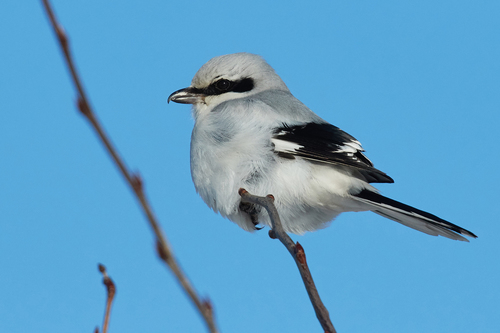


Great Grey Shrike
lanius excubitor
The Great Grey Shrike is a captivating predatory songbird often referred to as the 'butcherbird'. Despite its songbird classification, this species possesses predatory habits reminiscent of small raptors. It is famous for its unique hunting behavior of impaling prey on thorns, barbed wire, or sharp twigs. This serves a dual purpose: it secures the food since the shrike lacks the powerful grasping talons of hawks, and it stores food for later consumption in a specialized larder. Observing a Great Grey Shrike perched prominently atop a lonely tree or fence post, vigilantly scanning the landscape, is a thrilling highlight for any birdwatcher.
Hábitat: Typically found in wide open countrysides, such as heathlands, bogs, orchards, and clearings with scattered trees and thorny bushes.
This medium-sized bird features a striking plumage of contrasting ash-grey on its back and head, bright white underparts, and black wings with a bold white patch visible in flight. A defining feature is its stark black 'bandit mask' extending from the bill across the eyes. It has a heavy, black, hook-tipped bill, a long black tail with white outer feathers, and a wingspan of up to 36 centimeters, giving it a distinctive silhouette when scanning open terrain.
Categoría
AvesRareza
Common
Peligro
1/5 · Muy bajo
Snaps
¡Sé la primera persona en hacer un snap!
Male shrikes use their food larders to attract mates, with a larger and more diverse cache indicating a higher-quality partner.
The scientific genus name 'Lanius' is derived from the Latin word for butcher, referencing their unique feeding behaviors.
Their larders can contain dozens of impaled insects, rodents, and small birds, serving as a vital food reserve during cold spells.
Impales prey on sharp thorns or barbed wire to securely hold it while feeding and to store food for later.
Features a sharply hooked beak with a tomial tooth that allows it to quickly dispatch vertebrate prey without strong raptor talons.
Mimics the calls of other birds to defend territory or potentially lure smaller songbirds closer.
Feeds on a wide variety of small vertebrates and large insects, storing surplus catch on thorns.
Diferencias por edad: Chicks are primarily fed soft-bodied insects, transitioning to small vertebrates as they grow.
Microtus arvalis
Hunted as a primary food source, especially during winter months.
Accipiter nisus
Occasionally targeted by larger raptors in shared open environments.
Parus major
Smaller songbirds targeted as prey during the nesting season.
Aún no hay insignias de rasgos asignadas a este objeto.
Todavía no hay alias listados.
Las colecciones para este objeto aparecerán aquí a medida que se añadan más temas.
Peligro
1/5 · Muy bajo
Todavía no hay notas especiales de seguridad.
La forma más fácil de identificar a Great Grey Shrike es usar la aplicación de identificación de naturaleza Snappit.
Feeds on a wide variety of small vertebrates and large insects, storing surplus catch on thorns.
Typically found in wide open countrysides, such as heathlands, bogs, orchards, and clearings with scattered trees and thorny bushes.
Ambush
Acércate para separar los grupos y explorar dónde se ha fotografiado este objeto.
Los snaps recientes aparecerán aquí a medida que se añadan nuevas observaciones.








_female%2C_breeding_plumage.jpg&width=800)




