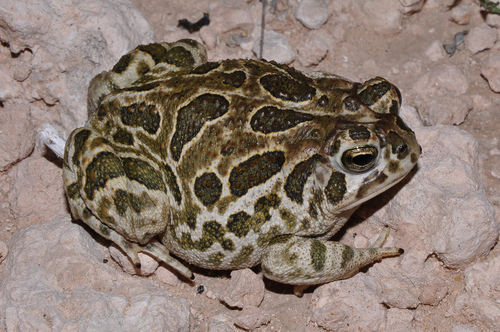


Great Plains Toad
anaxyrus cognatus
The Great Plains Toad (Anaxyrus cognatus) is a fascinating amphibian well-adapted to the semi-arid grasslands and prairies of North America. Known for its robust build and camouflage, it spends much of its life burrowed underground, emerging primarily during rains and at night. This species exhibits an impressive adaptation for survival in its often dry environment: explosive breeding. When suitable temporary pools form after heavy rainfall, large numbers of toads gather to mate, laying vast quantities of eggs that rapidly develop into tadpoles, ensuring the next generation can capitalize on fleeting water sources. Its distinctive trilling call, resembling a rapid, mechanical motor, is a quintessential sound of the plains during breeding season, making it a beloved, if sometimes elusive, inhabitant of its native range.
Hábitat: Found in grasslands, prairies, open woodlands, cultivated fields, and sandy areas, often near temporary or permanent water sources for breeding.
The Great Plains Toad is a medium-sized toad, typically ranging from 5 to 10 cm in length. Its skin is warty, varying in color from light gray or tan to olive-green or brown, with prominent, dark-edged, often paired blotches on its back. A light-colored stripe usually runs down the center of its back. It has noticeable cranial crests that form bony ridges on its head, converging between the eyes. The belly is generally white or cream-colored, sometimes with a few dark spots. Its pupils are horizontal.
Categoría
AnfibiosRareza
Common
Peligro
1/5 · Muy bajo
Snaps
¡Sé la primera persona en hacer un snap!
Despite being toads, they are surprisingly agile and can run rather than hop short distances when startled.
Tadpoles of this species develop exceptionally quickly, transforming into toadlets in as little as 17 days, a crucial adaptation for surviving in ephemeral pools.
The Great Plains Toad's call is a long, loud trill that can last up to 50 seconds, often described as sounding like a rapidly working jackhammer or motor.
They possess prominent bony ridges (cranial crests) on their heads, which help distinguish them from other toad species.
Utilizes powerful hind legs to rapidly dig burrows, retreating underground to escape predators, extreme temperatures, and dry conditions.
Engages in rapid, synchronized breeding events in temporary pools following heavy rains, allowing for quick reproduction and tadpole development before water bodies evaporate.
Possesses parotoid glands behind its eyes that secrete bufotoxin, a mild poison that deters most predators when the toad is threatened.
The Great Plains Toad primarily feeds on a variety of insects and other small invertebrates. It is an opportunistic predator that ambushes its prey.
Procyon lotor
A primary predator of Great Plains Toads, particularly juveniles.
Thamnophis radix
These snakes are common predators of amphibians, including Great Plains Toads.
Caelifera spp.
A main food source for the Great Plains Toad.
Formicidae spp.
Another common insect prey for the Great Plains Toad.
Aún no hay insignias de rasgos asignadas a este objeto.
Todavía no hay alias listados.
Las colecciones para este objeto aparecerán aquí a medida que se añadan más temas.
Peligro
1/5 · Muy bajo
Todavía no hay notas especiales de seguridad.
La forma más fácil de identificar a Great Plains Toad es usar la aplicación de identificación de naturaleza Snappit.
5-10 cm
0.05-0.2 kg
5-10 años
The Great Plains Toad primarily feeds on a variety of insects and other small invertebrates. It is an opportunistic predator that ambushes its prey.
Found in grasslands, prairies, open woodlands, cultivated fields, and sandy areas, often near temporary or permanent water sources for breeding.
Ambush
2000-20000
Acércate para separar los grupos y explorar dónde se ha fotografiado este objeto.
Los snaps recientes aparecerán aquí a medida que se añadan nuevas observaciones.








.jpg&width=800)






